
- Home
- Products
- About Us
- Custom Services
- Solutions
- Resources
- News
- Contact
Views: 0 Author: Site Editor Publish Time: 2026-06-25 Origin: Site


Commercial event planners, municipalities, and high-end residential designers face a recurring seasonal challenge. Selecting outdoor holiday decor is always a delicate balance. You must weigh visual impact against available budgets and logistical realities. Planners need to captivate audiences without overwhelming their operational resources. The choice between flat-plane and volumetric structures dictates far more than just the final guest experience. It heavily influences shipping volumes, installation timelines, and off-season storage limits. Making an uninformed choice can easily complicate an otherwise magical seasonal event.
This guide provides an objective evaluation of both flat and volumetric options. We will help you specify the right fixtures for your outdoor holiday projects. You will learn how to optimize physical space, maximize visitor engagement, and simplify long-term maintenance. We will explore structural differences, practical application strategies, and proven deployment frameworks. By the end, you can confidently build a highly efficient holiday display.
Spatial Strategy: 2D motif lights are highly efficient for perimeters, facades, and pole-mounting, while 3D LED motif lights serve best as highly interactive, 360-degree focal points.
Logistical Impact: Volumetric 3D structures require significantly more budget for shipping, anchoring, and off-season storage compared to flat-stacking 2D options.
The Hybrid Approach: The most cost-effective and visually dynamic outdoor Christmas motif lights often combine 2D infrastructure with 1–2 strategic 3D centerpiece installations.
Understanding the fundamental engineering behind holiday fixtures prevents costly design mistakes. Both flat and volumetric structures rely on similar lighting technologies. They both use IP65-rated LEDs and durable PVC rope lights. However, their structural frameworks differ immensely. These differences dictate how you deploy them across various venues.
Manufacturers design a 2D motif light using a flat, single-plane frame. These frames usually consist of lightweight aluminum or powder-coated iron. Technicians then meticulously wrap the metal skeleton with LED rope or string lights. This creates a distinct shape or silhouette. The defining characteristic of a flat fixture is its viewing angle. They are exclusively built for single-perspective viewing. Guests need to look at them directly from the front to understand the design.
Volumetric fixtures operate on an entirely different scale. 3D LED motif lights are multi-dimensional structures. Many of these pieces are life-sized or even massive walk-through installations. Manufacturers weld complex inner scaffolding to support the exterior lighting. Designers create these structures for 360-degree viewing and physical interaction. Guests can walk around them, step inside them, and pose for photos from any angle.
The transition from a flat plane to a volumetric shape introduces significant manufacturing complexities. Flat frames require basic two-dimensional welding. They are relatively light and consume minimal power per unit. Volumetric frames demand heavy-duty, structural-grade welding. They carry substantial physical weight to maintain their shape. Furthermore, volumetric pieces feature exponential increases in total LED counts. This drastically raises their overall power consumption.
Structural Feature | Flat-Plane (2D) | Volumetric (3D) |
|---|---|---|
Viewing Angle | Single perspective (front-facing) | 360-degree interactive |
Frame Welding | Simple perimeter and inner-line welds | Complex internal scaffolding |
LED Density | Moderate | Extremely high |
Physical Weight | Lightweight to moderate | Heavy (requires heavy lifting equipment) |
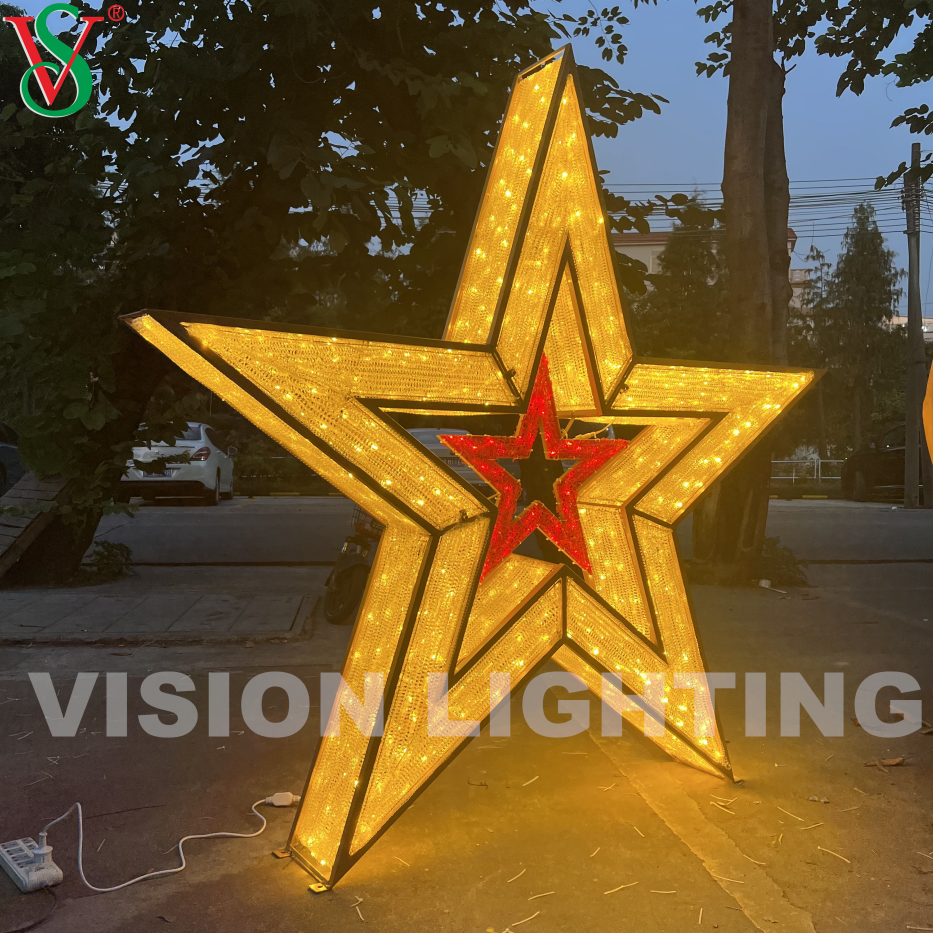
Matching the fixture type to the physical venue guarantees maximum visual return. Spatial evaluation is a critical step in your design process. You must map the specific features of your lights directly to the desired audience outcomes.
Flat displays thrive in spaces where audiences pass by in a linear fashion. They act as exceptional perimeter decorators. You should deploy them against large building facades, along chain-link fences, and above entry gates. They require a solid backdrop to truly stand out.
This format is also the undisputed industry standard for the street motif light. Municipalities mount these flat fixtures directly to light posts. They also string them across wide city boulevards using heavy-duty aerial cables. Motorists and pedestrians view them straight-on, creating a unified thematic corridor.
Volumetric displays command attention in wide-open environments. They are absolutely essential for public parks, town squares, and commercial shopping plazas. You place them where people naturally gather and linger.
These structures drive exceptionally high audience engagement. They serve as primary photo opportunities. Walk-through ornaments, giant glowing presents, and life-sized reindeer encourage guests to stop and interact. They transform a simple lighting display into a memorable physical destination.
Understanding spatial limitations is vital for a successful installation. A common mistake is placing flat displays in the middle of open ground. If a guest walks past a flat snowflake at a side angle, the design essentially disappears into a thin vertical line. The illusion breaks completely. Volumetric displays solve this problem entirely. They offer total immersion. Guests perceive the full shape regardless of their approach path.
Use flat fixtures to frame your space and create boundaries.
Place volumetric fixtures at the center of intersections or clearings.
Ensure guests have at least ten feet of clear space to photograph large walk-through pieces.
Avoid placing flat fixtures in the center of grassy expanses.
Visual appeal is only one part of the project. Implementation logistics dictate the feasibility of your entire seasonal program. Volumetric and flat fixtures present completely different operational challenges. You must account for manufacturing demands, freight logic, and off-season realities.
Volumetric structures naturally demand more raw materials. They require hundreds of additional feet of aluminum tubing. They utilize significantly higher LED counts to cover their multi-dimensional surface area. Consequently, they require intensive, specialized labor to assemble. This makes them considerably more resource-heavy per unit than their flat counterparts. Flat fixtures are highly efficient to produce, allowing you to stretch your procurement budget across larger areas.
Freight considerations often surprise first-time event planners. The logistics industry charges heavily for volumetric weight. A single giant volumetric display takes up substantial truck and container space. You are essentially paying to ship empty air trapped inside the welded frame. This drastically increases your freight budget. Conversely, flat frames pack densely. You can stack dozens of flat designs on a single shipping pallet. This maximizes container efficiency and protects your budget.
You must safely house these fixtures for ten months out of the year. Commercial storage space carries a hidden premium. Flat designs hang compactly on warehouse racks. They slide easily against walls or stack neatly under protective tarps.
Rigid volumetric pieces demand massive amounts of square footage. A ten-foot glowing ornament requires a ten-foot cube of dedicated warehouse space year-round. Some modern manufacturers now engineer collapsible volumetric designs. These fold down to mitigate space issues. However, fully welded rigid pieces still dominate the market. You must secure adequate facility space before ordering large structural pieces.
Logistical Phase | Flat Structures | Volumetric Structures |
|---|---|---|
Freight Footprint | Highly efficient (stackable) | Extensive (ships largely assembled) |
Warehouse Space | Minimal (hangs flat) | Substantial (demands high cubic volume) |
Material Density | Low to moderate | High (requires intensive scaffolding) |
Outdoor environments are unforgiving. Your installations must withstand severe weather while maintaining public safety. You must strictly adhere to compliance standards. Environmental durability heavily influences which fixture style you should choose.
Wind is the primary enemy of outdoor lighting installations. Volumetric fixtures act as massive wind-catchers in open spaces. The complex webbing of LED ropes creates a dense surface area. They require aggressive anchoring strategies. Installation crews must use heavy concrete ballasts, deep ground staking, or steel guy-wires. Failing to secure these pieces can result in dangerous structural tipping.
Flat displays face their own unique wind challenges. When crews mount flat designs onto light posts, high winds can twist them out of alignment. Installers must use heavy-duty stainless steel banding. They must tightly secure the brackets to prevent spinning or tearing during seasonal storms.
Electrical planning is another major logistical hurdle. Large walk-through structures often pull significantly higher amperages. They contain thousands of tightly packed diodes. You must provide dedicated, weather-proofed power drops at ground level. These connections require heavy-duty, NEMA-rated enclosures to prevent moisture intrusion from snow and rain.
Flat facade fixtures offer more electrical flexibility. Because they consume less power per unit, technicians can often tie them directly into existing architectural power sources. They rarely require dedicated ground-level trenching.
Even premium IP65-rated LEDs occasionally fail due to extreme weather or physical damage. Diagnosing a failed diode section is generally fast on a single-plane flat frame. A technician can quickly unclip the damaged PVC rope and splice in a replacement. Navigating the complex inner scaffolding of a volumetric structure is much harder. Technicians often have to reach through tight metal gaps to repair internal wiring.
Ignoring local wind-load engineering guidelines before erecting massive walk-through pieces.
Placing ground-level power connections in areas prone to heavy snowdrifts or puddles.
Using standard plastic zip-ties instead of stainless steel banding for pole-mounted fixtures.
Moving from theory to procurement requires a clear logic path. You need an actionable framework to finalize your vendor list. Following these structured steps will help you optimize your available resources.
You must rigorously evaluate your available physical space. Choose flat designs if your floor space is severely limited. They keep pedestrian traffic lanes completely unobstructed. They also prevent crowding on narrow sidewalks. Choose volumetric designs only if you have expansive, open plazas meant specifically for lingering and gathering.
Consider your ultimate event goals. Are you trying to generate social media buzz? If your goal relies heavily on user-generated content, you need volumetric pieces. The higher upfront budget required for immersive structures is easily justified by the organic marketing they create. Guests rarely take selfies with flat pole decorations. They consistently photograph themselves inside giant glowing tunnels.
The most successful planners recommend a hybrid procurement strategy. Relying on a single style often leaves a display feeling unbalanced. You should use outdoor Christmas motif lights in a coordinated mix. Use flat designs for your bulk coverage. They secure your perimeter, line your streetlights, and decorate massive walls while saving budget. Then, allocate your remaining resources to acquire two or three high-impact volumetric statement pieces. Place these securely in the center of your venue to serve as primary anchors.
Selecting the ideal outdoor holiday decor is a complex process. Neither flat nor volumetric designs are inherently better than the other. The right choice depends entirely on your site's physical constraints, available budget, and desired guest interaction. Flat displays offer unmatched logistical efficiency and perimeter scaling. Volumetric structures deliver unparalleled immersion and social engagement.
We strongly recommend that readers conduct a comprehensive site survey before making any purchases. You must accurately identify your power availability at ground level. You should also physically measure your off-season storage capacity. Taking these steps before finalizing vendor quotes will protect your budget and ensure a flawless seasonal installation. By embracing a hybrid design strategy, you can create a truly captivating holiday experience.
A: Yes, but they require strict safety protocols. Because they act as wind-catchers, installers must use heavy concrete ballasting, deep ground stakes, or steel guy-wires. We always recommend consulting local wind-load engineering guidelines before installing large volumetric pieces in open, unprotected areas.
A: Not always. You must verify bracket compatibility and the specific weight limits of the pole. Heavy winds add dynamic stress to the fixture. You also typically need municipal approval and must use heavy-duty stainless steel banding to prevent twisting.
A: Yes. Many manufacturers now offer folding volumetric frames. These collapsible designs heavily mitigate expensive shipping costs and solve off-season warehouse pain points. However, they may occasionally lack the absolute structural rigidity found in solid-welded permanent fixtures.


