
- Home
- Products
- About Us
- Custom Services
- Solutions
- Resources
- News
- Contact
Views: 0 Author: Site Editor Publish Time: 2026-08-17 Origin: Site


Huge holiday displays often create localized bottlenecks. Instead of flowing smoothly, crowds gather around a single static centerpiece. You lose potential retail revenue when foot traffic stalls in one spot. This congestion prevents visitors from exploring your entire event venue. Pop-up shops and food vendors in quieter zones suffer from terribly low engagement. Planners desperately need methods to distribute crowds evenly across a space. You must achieve this without deploying expensive extra security staff. Transitioning your holiday centerpiece into a strategic wayfinding tool solves this exact problem. We will explore how to evaluate, select, and map commercial lighting infrastructure effectively. You will learn to influence crowd movement safely using targeted illumination. Planners can easily increase visitor dwell time and drive venue-wide engagement through smart design.
Visual Anchoring: High-luminance installations pull crowds from low-traffic entry points toward high-value retail or food & beverage zones.
Dynamic Wayfinding: Programmable RGB systems use color-shifting and animation speeds to subconsciously dictate walking pace and direction.
Risk Management: Commercial deployments require strict adherence to IP65+ weather ratings, load calculations, and trip-free cable routing in high-footfall areas.
ROI Metrics: Success is measured not just by aesthetic impact, but by foot traffic redistribution and increased average dwell time in adjacent zones.
Understanding human behavior remains crucial for managing large crowds efficiently. Human visual perception naturally gravitates toward exceptionally bright objects. Event coordinators and retail managers call this the "Moth Effect." People naturally walk toward highly structured light sources in dark environments. A brightly lit commercial centerpiece acts as a massive visual magnet. It easily pulls crowds from low-traffic entry points toward more profitable zones. You can leverage this psychological trait to guide crowds effortlessly without physical barricades.
You must actively avoid creating a single massive bottleneck at your venue. Planners solve this by breaking the main attraction into smaller, scattered segments. You should use secondary, scaled-down lighting installations to achieve this goal. These smaller elements pull visitors away from overcrowded primary entrances quickly. They create a natural flowing path deep into your event space. Dispersing the visual weight encourages people to keep moving forward.
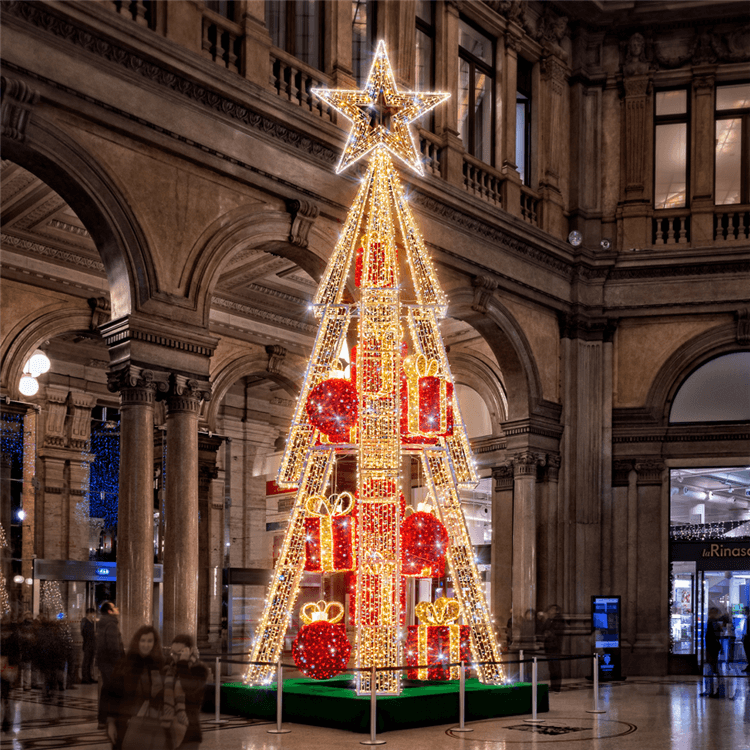
Establishing clear visual hierarchies keeps visitors moving in a logical direction. You must differentiate between your primary destination and smaller breadcrumb paths. The destination is usually the massive main centerpiece. Breadcrumb paths consist of smaller, cohesive lighting elements leading up to it. This hierarchy subconsciously tells people exactly where they should walk next. It prevents confusion and keeps pedestrian traffic flowing smoothly. Integrating a strategic commercial Christmas tree light system serves this precise operational purpose.
Making breadcrumb lights brighter than the main destination piece.
Placing massive installations too close to the main venue entrance.
Ignoring the ambient light spill from nearby street lamps.
You must choose the correct structural frame to manage foot traffic effectively. Traditional conical structures and walk-through frames serve entirely different crowd-control purposes.
Walk-through trees force physical interaction from your visitors. They naturally create a one-way or two-way traffic tunnel. Visitors love walking inside them to take holiday photos. This continuous movement keeps the crowd flowing efficiently through specific corridors. You can place them over existing walkways to upgrade basic pathways.
Solid visual barriers serve a more defensive architectural purpose. You can use traditional conical designs to block dead-ends beautifully. They gently redirect crowds around restricted staging areas or utility zones. They provide clear physical boundaries without feeling like a harsh security fence.
Adding complementary ground-level elements strongly enhances your overall wayfinding strategy. You can install pole-mounted 3D motif Christmas lights to create a cohesive trail. These smaller themed displays lead visitors directly toward the main attraction. The main focal point is usually your massive outdoor LED Christmas tree. This connected lighting ecosystem keeps guests moving along your specifically desired path. Matching colors and shapes tie the entire venue map together perfectly.
You also need to evaluate pixel density very carefully before purchasing. Higher LED density means more lights per foot of physical wiring. Main focal points absolutely require a very high pixel density. Visitors view these primary displays up close and expect stunning clarity. Perimeter wayfinding installations can easily use much lower pixel density. You can space those bulbs further apart to manage your budget efficiently. Distant viewer perception blends spaced-out lights together naturally.
You must carefully assess the business case for individual pixel control. Planners often debate between static lights and fully programmable LEDs. Static lights offer simple elegance but provide zero operational flexibility. Addressable systems let you control every single bulb individually via software. They provide limitless options for pacing, mapping, and complex animation.
Lighting Systems Control Comparison Chart
Feature | Static LED Systems | Programmable RGB Systems |
|---|---|---|
Pixel Control | None (Entire string acts as one) | Individual node control |
Wayfinding Utility | Low (Functions only as a beacon) | High (Can display directional arrows) |
Animation Speeds | Fixed blinking or solid on | Fully adjustable via software |
Maintenance | Simple bulb replacement | Requires technical troubleshooting |
Pacing and animation capabilities directly influence human crowd behavior. You can program fast, chasing patterns to actively accelerate movement. These rapid sequences work perfectly in narrow transit corridors or choke points. They visually tell people to keep walking at a brisk pace. Conversely, slow color transitions heavily encourage lingering and observation. We use slow, fading effects in vendor areas and food courts. They subtly convince visitors to stay longer and buy more items. Properly sequenced RGB outdoor holiday lighting subconsciously dictates walking speeds across your site.
Control infrastructure is equally important for scaling your lighting setup successfully. You need robust software and hardware integrations to prevent system crashes. DMX controllers remain an absolute industry standard for live commercial events. WLED systems offer excellent flexibility for custom architectural setups. Cloud-based scheduling allows remote management across multiple disconnected venue zones. You must shortlist ecosystems integrating easily into your existing network infrastructure. Ensure your chosen hardware supports the total number of pixels deployed.
Where you place your lights directly determines your venue's overall profitability. Mapping your installation to specific zones guarantees even footfall distribution. The primary node serves as your ultimate anchor placement. You should position your main LED Christmas Tree Light installation very carefully. Place it at the deepest accessible point of your venue. This specific positioning forces visitors to navigate the entire site footprint. They must walk past numerous retail vendors to reach the main attraction.
You must also establish secondary nodes within your transition zones. Place matching mid-sized trees at major path intersections. These act as vital visual checkpoints for your guests. They prevent visitor drop-off and maintain interest between major attractions. When visitors see another display ahead, they continue exploring deeper.
Monetization zones require the most aggressive lighting strategies available. You should align your brightest sequences strictly adjacent to high-margin stalls. Brightly lit pop-up shops and ticketing booths attract more wallets immediately. Planners often use color-shifting lights to highlight specific temporary vendor locations. This tactic directly drives higher sales conversions in targeted commercial areas. If a specific vendor needs more traffic, illuminate the path toward them.
Map the venue's natural foot traffic flow during daylight hours first.
Identify areas where shadows naturally obscure vendor signage.
Place interactive light features exclusively near food and beverage areas.
Keep emergency exits completely free from distracting lighting sequences.
Commercial setups fail rapidly without proper and rigorous weatherproofing protocols. Standard residential IP44 ratings cannot survive long-term commercial deployments. They fail quickly under heavy rain, high winds, or deep snow. You must establish IP65 as your strict baseline for hardware procurement. This rating guarantees outdoor durability against severe elements and moisture intrusion. It protects your expensive investment during brutal winter freeze-thaw cycles. Commercial fixtures also utilize watertight coaxial connectors instead of standard prongs.
Power loads and voltage drop present highly serious technical challenges. Connecting multiple commercial strings in series causes immediate electrical problems. The voltage drops significantly across long distances of thin copper wire. You lose noticeable brightness at the far end of the run. Colors may also render incorrectly due to insufficient data signals. Technicians solve this using strategic power injection points. They run parallel heavy-gauge power lines to maintain uniform luminance everywhere.
Public safety and cable management require constant vigilance from your team. Trip hazards in high-flow areas invite disastrous lawsuits and injuries. You must vigorously mitigate these risks through elevated rigging techniques. Suspend power cables high above pedestrian walkways whenever physically possible. Use ADA-compliant heavy-duty cable ramps for any necessary ground-level wire crossings. Secure all commercial power supplies far away from public access. Lock them inside weatherproof, tamper-resistant enclosures to prevent accidental electrocution.
Selecting the right partner determines your commercial project's ultimate success. You must rigorously assess specific vendor capabilities during the initial quoting phase. Ask vendors if they offer site-specific power mapping services. Do they provide custom node spacing for your unique spatial dimensions? Many basic vendors only sell standard off-the-shelf residential products. Commercial event spaces usually require heavily customized engineering solutions. You need a partner capable of generating accurate schematic drawings beforehand.
Your first actionable next step is drafting a comprehensive site plan. You need to identify all "cold zones" across your current venue. These are specific areas suffering from chronically low foot traffic. Mark them clearly on your venue map with red ink. Provide this physically marked map directly to your commercial lighting vendors. This action gives them a crystal-clear business objective during the design phase. They can map out dynamic light sequences specifically aimed at warming up those cold zones.
Managing crowd flow requires substantially more than just beautiful holiday decorations. Strategic illumination turns a chaotic venue into a highly optimized retail pathway. You can successfully guide crowds, prevent bottlenecks, and boost overall engagement simultaneously. We highly recommend taking these concise, actionable next steps immediately to optimize your space.
Audit your existing site map to locate high-congestion bottlenecks.
Designate your deepest physical point for the main anchor installation.
Choose addressable lighting systems to dynamically control visitor walking speeds.
Verify all procured equipment meets strict IP65 commercial weatherproofing standards.
A: Commercial installations require significantly more density than basic residential setups. Planners typically use 100 to 150 bulbs per foot of height. You must also factor in branch density and specific pixel-mapping requirements. Highly detailed animations demand much closer node spacing to display recognizable graphics clearly. Always consult your vendor for exact mathematical calculations.
A: Yes, they absolutely can. Lighting psychology principles heavily prove visual pacing affects human movement. Rapid, chasing sequences in transit corridors subconsciously encourage people to walk faster. Slow, gentle cross-fades strongly promote stationary viewing and lingering. You can use these programmable effects to manage crowd density dynamically.
A: Commercial versions feature heavy-duty structural steel framing designed specifically for public spaces. They utilize IP65+ waterproof coaxial connectors instead of standard residential plugs. Commercial setups also feature much heavier gauge wire to handle longer runs without voltage drop. They use individually repairable LED nodes to minimize long-term maintenance issues.


