
- Home
- Products
- About Us
- Custom Services
- Solutions
- Resources
- News
- Contact
Views: 0 Author: Site Editor Publish Time: 2026-08-24 Origin: Site


Selecting the perfect illumination for large-scale holiday displays goes far beyond mere aesthetic preferences. It becomes a critical technical procurement decision. A well-designed setup must carefully balance striking visual impact with robust durability, power efficiency, and actual installation realities. The stakes run incredibly high in municipal, retail, and corporate environments. If a system fails, you face noticeable dead zones, endless maintenance nightmares, and poor return on investment.
We designed this guide to help you navigate these complex requirements confidently. You will learn how to evaluate various effect categories, ranging from basic static glows to fully programmable light shows. We also detail how to assess commercial-grade hardware metrics and calculate precise density requirements. Finally, we cover proven strategies to help you avoid common implementation failures. Let us dive into the technical details that separate amateur displays from stunning commercial successes.
Effect vs. ROI: Static warm-white LEDs offer the highest reliability and lowest maintenance, while RGB programmable systems drive foot traffic but require specialized controllers and higher upfront investment.
Hardware baseline: True commercial-grade strings require coaxial connections, minimum 20-AWG wiring, and IP65+ ratings to survive winter elements.
Scale calculation: Outdoor tree density isn't a guess; it requires strict formulas based on tree height, viewing distance, and canopy volume to prevent voltage drop and ensure uniform brightness.
System integration: Mixing standard string lights with 3D motif Christmas lights creates depth, but requires aligned color temperatures and compatible power loads.
Choosing the right visual strategy defines your entire project. You face three main categories. Each solves different business problems and requires different operational resources.
First, consider static warm or cool white displays. They represent the industry standard for traditional, high-end environments. Static lights deliver exceptional architectural harmony. They also require very little maintenance across multiple years. However, you must remain highly skeptical about color consistency. You should ensure exact Kelvin matching across all batches. If you mix 2700K and 3000K strands on the same canopy, the tree looks heavily disjointed. Consistent color temperatures signal premium quality to your visitors.
Second, look at pre-programmed animation. These systems offer chasing, fading, or twinkling effects. They use basic built-in controllers. This approach provides a cost-effective way to add motion. You avoid complex software requirements and extensive networking. Yet, you face a significant risk. These systems are prone to out-of-sync looping over long runs. If a controller fails, the sequence breaks entirely. Uneven power resets also ruin the visual timing across different sections.
Third, explore fully programmable solutions. You might invest in RGB outdoor holiday lighting. These setups use individually addressable pixels. Technicians often control them via DMX protocols. You need this technology for synchronized music shows. It also supports sponsor branding and creates high-engagement social media backdrops. However, the implementation reality is harsh. The hardware costs significantly more. You must hire technical staff for custom pixel mapping. Furthermore, data-injection nodes introduce potential failure points during heavy snowstorms.
Strategy | Primary Benefit | Technical Risk | Best Application |
|---|---|---|---|
Static White | Highest reliability, lowest upkeep | Mismatched Kelvin temperatures | Classic civic centers, luxury retail |
Pre-Programmed | Inexpensive motion effects | Out-of-sync sequence loops | Mid-sized community parks |
Programmable RGB | Maximum social media engagement | Complex mapping, node failures | Ticketed light shows, corporate HQs |
Selecting a commercial Christmas tree light requires strict hardware evaluation. Retail products fail quickly in public spaces. You must understand key performance dimensions to protect your investment.
We evaluate hardware based on specific criteria. You should demand compliance with strict outdoor standards. Here are the core specifications you cannot ignore:
Ingress Protection (IP Rating): Many buyers mistakenly purchase IP44 lights. You should strictly reserve IP44 for protected residential use. A commercial setup demands IP65 or IP67 ratings. IP65 resists direct water jets from storms. IP67 allows temporary submersion in freezing puddles. Winter elements easily destroy lower-rated plastic housings.
Wire Gauge and Build Quality: Retail strings often use cheap 22-AWG wire. This thin wire breaks easily under physical tension. Commercial environments require 20-AWG wire minimum. The heavier gauge prevents wind-shear breakage. It also heavily minimizes voltage drop across runs exceeding 100 feet.
Rectifiers and Flicker Rates: Cheap LEDs suffer from the "strobe effect." Human eyes might miss it, but cameras capture it instantly. Commercial setups must use full-wave rectifiers. These components ensure continuous, flicker-free illumination. This feature is absolutely crucial. Modern crowds photograph environments heavily using smartphones, and flickering ruins videos.
Secure Connectors: You must reject standard end-to-end friction plugs. They easily pull apart. Instead, mandate threaded coaxial connectors. These connections feature integrated O-rings. They completely prevent moisture ingress. They also stop accidental disconnections caused by heavy wind loads on the branches.
Component | Retail Standard (Avoid) | Commercial Standard (Require) |
|---|---|---|
Wire Thickness | 22-AWG | 20-AWG or heavier |
Weather Sealing | IP44 (Splash-proof) | IP65+ (Jet-water resistant) |
Connection Type | Standard 2-prong plug | Threaded Coaxial with O-ring |
Power Delivery | Half-wave rectifier | Full-wave rectifier (Flicker-free) |
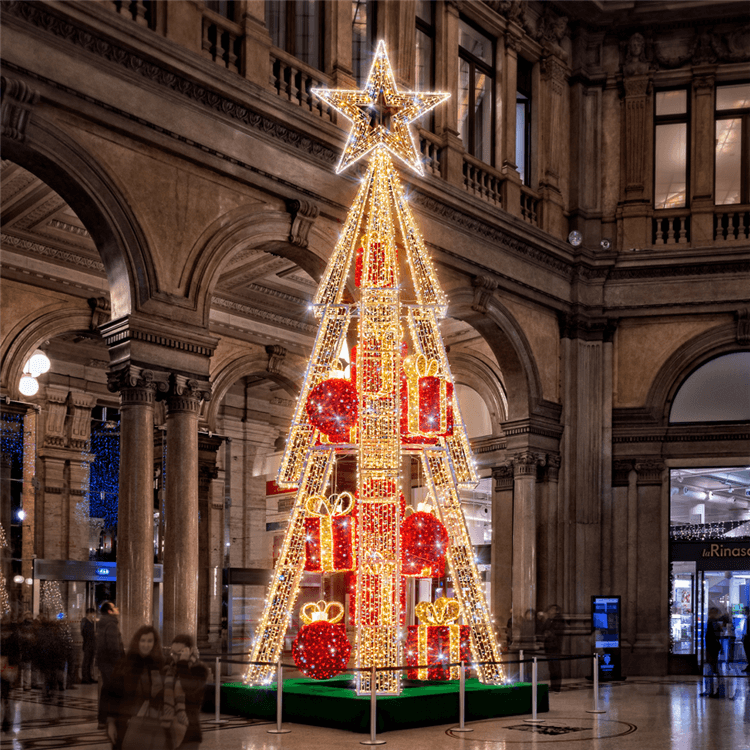
Planning an outdoor LED Christmas tree requires precise math. You cannot guess the required density. Scalability demands quantifiable planning and strict formulas.
Let us introduce a reliable calculation framework. You must distinguish between trunk wrapping and canopy draping. Canopy draping calculates total surface area. You measure the circumference at the base. Then, you calculate the slant height up to the star. Wrapping a trunk requires different math entirely. You divide the trunk height by your desired string spacing. Then, you multiply that number by the trunk's circumference to find total linear footage.
Viewing distance heavily dictates your optimal bulb spacing. You must adapt to the audience's location.
Pedestrian zones: Use 6-inch spacing for close-quarters viewing. Tight density looks complete up close.
Highway installations: Use 12-inch spacing for distant installations. Distant viewers blend the light naturally, saving you money on hardware.
Focal points: Apply 4-inch spacing for intense, ground-level centerpieces. This creates maximum visual impact where selfies happen most.
Voltage drop strictly limits your design capabilities. You face hard physical boundaries when connecting end-to-end strings. Every wire has natural resistance. Power drops steadily over long distances. Eventually, lights dim noticeably at the end of the line. You must know your maximum run lengths before installation begins. Once you hit the limit, you require a new power tap or amplifier.
You must also understand voltage differences transparently. Standard 120V systems allow much longer continuous runs. They often support hundreds of feet on a single plug. Low-voltage 12V or 24V systems operate differently. They require power injection much sooner. However, low-voltage systems offer superior electrical safety in wet public areas. They eliminate severe shock risks if animals chew through the wires.
Adding 3D motif Christmas lights creates incredible visual depth. These elements transform a basic lighting job into a premium attraction. They break up the uniformity of standard wrapped strings.
We define 3D motifs as large-scale, self-contained LED structures. They include glowing stars, massive spheres, or giant intricate snowflakes. Installers integrate them directly into the tree's primary framework. They act as oversized ornaments that emit brilliant light. Mixing standard strings with these motifs creates dynamic layers.
You must carefully evaluate weight and wind load. These heavy structures catch winter winds easily like a sail. You need robust structural integrity. Mounting heavy motifs on outdoor artificial branches poses severe bending risks. Natural trees also face structural failure if overloaded on weak limbs. You should anchor large motifs directly to the central steel frame of artificial trees. For live trees, use tension cables attached to the thickest part of the main trunk.
Power segregation is a critical best practice. You should run motifs on entirely independent power circuits. Do not daisy-chain them into the primary tree strings. This segregation isolates electrical faults perfectly. If a motif shorts out from heavy snow buildup, the main tree stays lit. Separate circuits also simplify troubleshooting significantly. Technicians can diagnose isolated circuit issues much faster in freezing weather.
Even the most expensive LED Christmas Tree Light setup fails without proper execution. You must plan extensively for installation, security, and long-term maintenance.
Installation labor represents a massive hidden challenge. Complex effects require meticulous pixel placement. Wrapping a commercial tree tightly takes dozens of man-hours. A simple vertical drape takes a fraction of the time. You must factor in expensive bucket trucks, lift rentals, and specialized labor. Do not underestimate the time required to secure hundreds of coaxial connections perfectly.
Safety and compliance remain completely non-negotiable. Fire marshals inspect public installations rigorously. You must ensure all components are UL or ETL listed. They must carry specific certifications for outdoor commercial use. Municipal insurance requirements demand this documentation. Unlisted products expose your organization to severe legal liability if electrical fires occur.
You should always insist on a fail-safe approach. Standard retail lights fail completely if one bulb dies. You must specify single-bulb failure systems for commercial jobs. In these commercial strings, one dead pixel never kills the whole line. The internal shunt bypasses the broken diode. The rest of the strand continues shining brightly. This specific feature prevents massive dark spots in your expensive display.
Storage and takedown procedures matter immensely for longevity. Improper removal destroys more lighting than extreme winter weather. Crews often yank strings down violently to save time. This action stretches the copper and breaks internal solder connections. You must enforce proper, careful spooling techniques. Furthermore, programmable RGB components contain sensitive microchips. You need climate-controlled storage to protect them from extreme summer heat and humidity during the off-season.
Let us recap the shortlisting logic. You face a clear decision matrix based on your primary constraints. If your budget is strictly fixed, avoid cheap programmable systems. You should prioritize high-quality static commercial wire instead. It guarantees longevity and reliability. However, if audience engagement and marketing drive your goals, change your tactics. You should invest heavily in programmable RGB systems. Just ensure you budget adequately for custom software mapping and skilled maintenance.
Take specific next-step actions before purchasing. You should always request physical spec sheets from vendors. Do not rely on verbal promises regarding wire gauge or IP ratings. Verify the exact Kelvin temperatures for all white lights to ensure visual harmony. Finally, demand robust warranty terms. A strong contract must cover UV degradation and early moisture failure. Secure these exact terms before signing any vendor agreement.
A: A high-quality commercial string typically lasts 3 to 5 seasons in outdoor environments. Longevity depends heavily on UV exposure, wind sheer, and takedown care. While LED bulbs theoretically run for thousands of hours, the plastic housings and wiring degrade over time. Proper climate-controlled storage extends their lifespan, dispelling the myth that LEDs last forever outdoors.
A: We strongly advise against mixing them on the exact same branches. It causes visual clutter and looks disorganized. Technical difficulties also arise because they require entirely separate controllers and power systems. If you must mix them, use static LEDs for the dense canopy base, and reserve RGB strictly for distinct, large-scale structural motifs.
A: The 5mm wide-angle conical bulb provides the best overall performance. Unlike traditional C7 or C9 bulbs that shoot light directionally, the 5mm conical shape disperses light evenly in a wide halo. It is also a single-piece molded design, making it far more durable and moisture-resistant than screw-in bulbs.
A: You must physically elevate all connection points above the ground to avoid sitting water. Apply dielectric grease inside every plug before connecting them. Most importantly, use threaded coaxial seals on every joint. Sealing connections completely blocks moisture ingress, which is the primary cause of frustrating GFCI faults.


