
- Home
- Products
- About Us
- Custom Services
- Solutions
- Resources
- News
- Contact
Views: 0 Author: Site Editor Publish Time: 2026-07-22 Origin: Site


Overhead lighting instantly transforms ordinary municipal streets into vibrant destination hubs. These dazzling aerial displays capture attention, naturally drive pedestrian foot traffic, and significantly extend visitor dwell time during the critical holiday season. However, installing heavy infrastructure over active public roadways demands meticulous planning and engineering. Planners must navigate complex structural limitations, strict electrical safety codes, and rigorous local compliance variables. These challenges go far beyond standard commercial decorating projects seen on private properties.
This comprehensive guide breaks down the essential technical requirements and critical product selection criteria you need. We detail the strict safety protocols necessary for city planners, municipal engineers, and festival organizers. Apply these insights to properly select fixtures, manage structural loads, and execute compliant, high-ROI overhead displays safely.
Framing an overhead lighting investment requires looking past the initial seasonal expense. Municipalities and business improvement districts should view these installations as powerful economic drivers. Properly executed street lighting directly correlates to increased local retail revenue. Evening restaurant bookings surge when festive atmospheres encourage visitors to linger. Social media visibility also spikes as attendees share photos of illuminated avenues. You establish a clear metric for success when you measure community engagement alongside this tangible retail footfall.
Continuous overhead lighting serves a highly functional purpose through placemaking and wayfinding. A cohesive canopy of lights acts as a visual ceiling. It guides festival attendees intuitively through specific commercial corridors. You naturally funnel crowds away from dead zones and toward vendor stalls, local boutiques, or main event stages. This psychological guidance keeps visitors moving smoothly along desired economic paths.
Balancing budgeting realities remains a primary challenge for city organizers. You must weigh upfront capital expenditure against ongoing operational costs. Capital expenses include heavy-duty infrastructure, professional rigging hardware, and durable fixture procurement. Operational costs include specialized installation labor, monthly power consumption, and safe off-season storage. You protect your investment by choosing robust materials designed to survive decades of seasonal deployment rather than cheap alternatives requiring constant replacement.
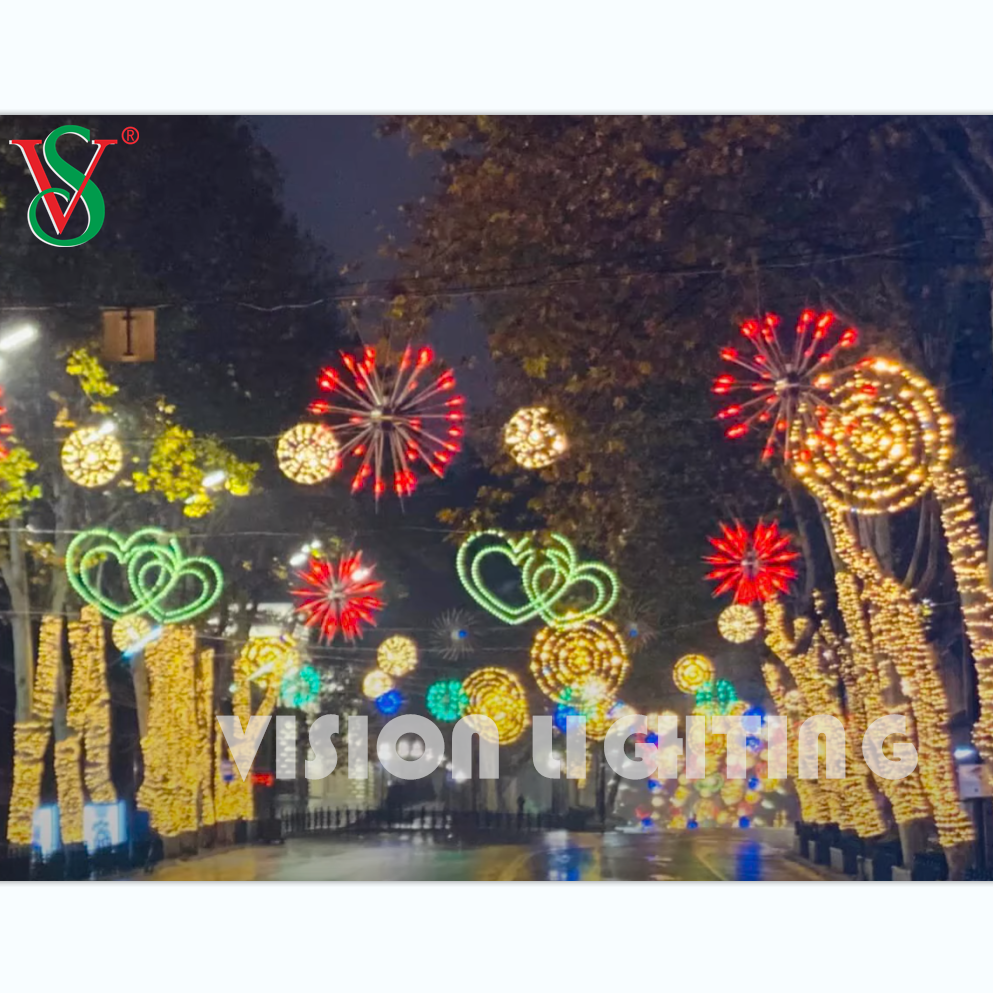
Deciding between standard string lighting and structured motif displays dictates your entire structural approach. Standard commercial string lights provide a classic, ambient glow across wide areas. However, structured motifs deliver distinct, recognizable branding for a municipality. Motifs generally offer superior durability. They hold their rigid shapes better during severe winter weather compared to loose strands.
Integrating a street motif light requires evaluating both pros and cons. Rigid frame fixtures act as massive visual centerpieces, drawing immense public attention. Yet, you must rigorously evaluate wind resistance. Large overhead centerpieces act like sails in high winds. They carry significant weight implications. A heavy central fixture increases the tension required on the supporting suspension cables.
When reviewing options, engineers often prefer specific formats for safety reasons. A well-designed 2D Christmas motif light is almost always favored over a 3D variant for across-street spans. Flat 2D frames generate significantly lower wind drag. They stack flat, making off-season storage much easier. Most importantly, their lighter profile reduces the extreme weight strain placed on historic building anchor points.
Procurement teams must demand strict minimum specifications for outdoor festival lights. Commercial use dictates IP65 waterproof ratings as an absolute baseline. Coaxial threaded connectors are mandatory to prevent water ingress and accidental disconnection in high winds. Heavy-gauge wire helps withstand environmental tension. Finally, high-efficiency LED nodes are essential to keep overall amperage low across long municipal runs.
Comparison of Commercial Street Lighting Formats
| Feature | Standard String/Bistro Lights | 2D Motif Displays |
|---|---|---|
| Visual Impact | Ambient, widespread atmospheric glow. | Distinct, branded, high-contrast focal points. |
| Wind Resistance | High (air passes easily through strands). | Moderate (requires structural wind-load calculation). |
| Weight Load | Low strain on municipal anchor points. | Moderate to High strain, depending on frame size. |
| Storage Logistics | Easy (spooled into compact bins). | Moderate (stores flat, requires racking systems). |
Standard Department of Transportation (DOT) height clearances dictate where you can hang overhead infrastructure. Vertical clearance requirements typically range from 15 to 18 feet above the roadway. This height depends heavily on emergency vehicle access and commercial freight routes. Fire trucks require completely unobstructed paths. A sagging line creating a clearance violation poses severe municipal liability.
Securing structural engineering sign-offs for anchor point integrity is non-negotiable. You must carefully evaluate existing infrastructure before attaching any load. Building facades, especially older masonry, require professional pull-testing. Dedicated municipal light poles often lack the lateral load-bearing capacity for heavy cross-street tension. Never assume a vintage brick wall can safely support a new 200-pound dynamic load.
Understanding wind load and tension dynamics separates successful installations from catastrophic failures. Wind shear pushes against large motifs laterally. This lateral force dramatically increases the tension on your long-span cable suspensions. If tension is too loose, the display sags into traffic lanes. If tension is too tight, temperature drops can shrink the metal, potentially pulling anchors directly out of the mounting surface.
Navigating the permitting and liability landscape requires patience and documentation. Map out the typical municipal approval process early. You usually need dedicated right-of-way permits and specific insurance minimums. Traffic control plans must be approved by local police or public works departments prior to deploying any installation crews on active roads.
Fixtures should never bear their own weight across a broad street span. You must implement a catenary wire system. This involves using aircraft-grade galvanized steel cable as the primary load-bearing support. You then attach the decorative elements to this high-tension steel line. This prevents electrical wire stretching, jacket tearing, and catastrophic mid-season snapping.
Proper application of tensioning hardware ensures the system remains secure through winter storms. Installers must utilize forged turnbuckles to dial in the exact tension required. Wire rope clips (often called Crosby clips) and protective thimbles prevent slippage. Thimbles are critical because they keep the steel wire from kinking and fraying at the anchor attachment point.
Electrical load management prevents massive lighting failures during peak hours. You must calculate total amperage limits accurately based on the circuit breakers available. Prevent voltage drop across wide streets by utilizing lower-gauge (thicker) wire. Sometimes, injecting power from both ends of the street is necessary. Always secure weatherproof NEMA-rated junction boxes well out of public reach.
Safety protocols during rollout protect both the installation crew and the public.
Reject vendors lacking fundamental specification transparency. Reputable manufacturers must provide exact fixture weights, calculated wind load ratings, and precise electrical draw data. Guessing these numbers inevitably leads to structural failures or tripped municipal breakers. A trusted partner will present detailed specification sheets for every across street Christmas lights package they propose.
Assess the vendor's capability regarding customization versus off-the-shelf products. Street widths vary wildly within a single downtown district. Localized cultural themes matter to your community. A superior lighting partner adapts their frame dimensions and aesthetic designs to fit your specific municipal layout seamlessly.
Evaluate the vendor's supply chain reliability and replacement part availability. Even commercial LEDs eventually degrade or suffer impact damage. You need backup power supplies shipped fast. Ask potential vendors about their standard turnaround times for repairing damaged units mid-season. A warranty means little if parts take months to arrive.
Initiating next-step actions early secures a smooth project timeline. Schedule comprehensive site surveys with your chosen vendor immediately. Request structural load data to submit to your municipal engineers. Secure physical sample units for quality assurance testing before you finalize any bulk procurement contracts.
Executing a successful overhead lighting project requires treating structural safety and strict compliance as your top priorities. Stunning aesthetics only matter if the installation remains securely and legally suspended above the public. Balancing artistic vision with rigorous engineering ensures your municipality avoids liability while maximizing community engagement.
We strongly recommend starting the procurement and planning phases in the second or third quarter of the year. Early action guarantees you secure necessary DOT permits, engineering sign-offs, and custom manufacturing slots well before the holiday rush.
Take the next step toward transforming your commercial corridors. Contact a commercial lighting specialist today to schedule a site-specific evaluation, request structural load data, and build a comprehensive infrastructure quote tailored to your city's exact dimensions.
A: Standard DOT regulations typically require a vertical clearance of 15 to 18 feet above the roadway. This height ensures unobstructed passage for emergency vehicles, particularly fire trucks, and commercial freight transport. Always verify specific local municipal codes, as designated truck routes may demand even higher minimum clearances.
A: You should never attach heavy motifs to utility poles without prior authorization. You must conduct structural load assessments and secure formal approvals from the utility company first. Adding lateral tension and wind load to older poles can compromise their integrity or violate local utility right-of-way regulations.
A: Prevent voltage drop by using lower-gauge (thicker) electrical wire that carries current more efficiently over long distances. For exceptionally wide streets, engineers often balance the electrical load across multiple circuits or utilize power injection points at both ends of the display to maintain consistent brightness.
A: 2D motifs are generally better for overhead suspensions. They offer significantly reduced weight and present less surface area, which minimizes hazardous wind resistance. Additionally, 2D frames simplify mounting logistics and require much less space for off-season storage compared to bulky 3D alternatives.


