
- Home
- Products
- About Us
- Custom Services
- Solutions
- Resources
- News
- Contact
Views: 0 Author: Site Editor Publish Time: 2026-08-13 Origin: Site


Sourcing commercial lighting for municipal displays, retail centers, or large-scale events demands more than aesthetic vision. You must transition a conceptual design into a compliant, weather-resistant physical asset. The gap between an artistic sketch and factory reality often hides significant risks. You might encounter structural integrity failures during high winds. Inadequate Ingress Protection (IP) ratings can cause water damage. Poor electrical compliance can halt public installations entirely.
Our purpose is to provide a transparent, step-by-step evaluation framework. We want to help you commission these installations with total confidence. By following this guide, you will learn how to translate creative ideas into rigorous manufacturing specifications. You ensure the final product meets strict design, durability, and safety requirements. You will avoid costly surprises on the assembly line. Ultimately, you protect your project timeline and deliver a flawless visual experience.
Design Feasibility: Converting 2D art into a structural 3D motif light requires early alignment on frame materials (aluminum vs. iron) and weight distribution.
Prototyping Mitigates Risk: A mandatory sampling phase prevents costly mass-production errors related to LED density, color temperature, and voltage drops.
Compliance & Durability: Reputable factories validate custom Christmas lights and architectural motifs through strict IP65+ waterproof testing and CE/UL certifications.
Vendor Selection: Shortlist manufacturing partners based on R&D engineering capabilities, transparent MOQs, and integrated installation support rather than unit price alone.
Vague design briefs lead directly to inaccurate factory quotes and misaligned expectations. You might send a beautiful rendering to a manufacturer. However, if you omit structural details, factories will make assumptions. These assumptions often compromise the final product. Requirement gathering anchors the entire production cycle. You must establish strict boundaries before engineers can draft their blueprints.
Here are the core requirements you must define immediately:
Dimensional Limits and Constraints: Specify the exact height, width, and depth. You must also account for transport constraints. Oversized pieces cannot fit into standard 40-foot containers without modular breakdowns.
Application Environments: Indoor displays face different challenges than outdoor installations. Coastal environments require advanced salt-spray resistance. Extreme cold requires materials that resist freezing and cracking.
Power and Voltage Specifications: Low voltage systems (24V or 36V) offer greater safety. You need them for public touchpoints or pedestrian zones. High voltage systems (120V or 240V) suit elevated or massive architectural installations where voltage drop becomes a concern over long distances.
The engineering handoff bridges the gap between art and reality. Factories take your initial sketches or CAD files. They evaluate them for structural feasibility. Engineers identify potential weak points in the design. They calculate where structural cross-bracing is necessary. They then translate your vision into actionable wiring plans and structural frame blueprints. This meticulous process sets the foundation for your custom LED motif lights. You cannot skip this phase without risking the safety and aesthetics of your installation.
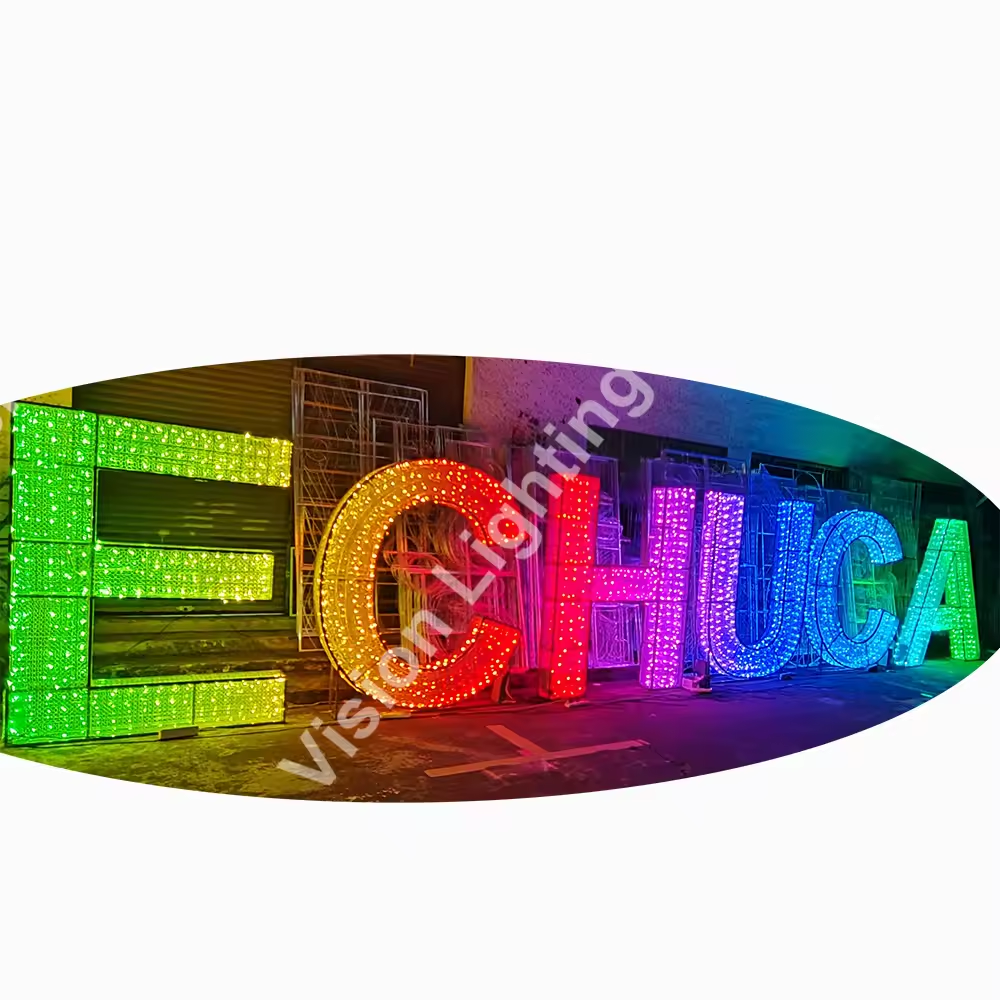
Moving from a digital rendering to a physical prototype tests both form and function. A computer screen cannot accurately simulate real-world physics. You need a physical sample to validate the structural integrity of a 3D motif light. This solution approach mitigates risk before you commit to mass production.
Frame construction requires critical material decisions. You must evaluate the structural core of your design.
Frame Material Comparison
Material Type | Weight | Corrosion Resistance | Best Application Scenarios |
|---|---|---|---|
Powder-Coated Aluminum | Lightweight | Very High (Naturally rust-proof) | Suspended displays, coastal regions, frequent installations. |
Treated Iron (Galvanized) | Heavy | Moderate to High (Depends on coating) | Massive ground structures, high wind-load areas. |
Aluminum offers easy handling and natural rust defense. Iron provides higher tensile strength. You need iron for multi-story structures that face severe weather.
Once the frame is built, engineers focus on illumination mapping. They determine exact LED rope light density. They integrate neon flex materials and specify point-light spacing. This guarantees uniform brightness across the entire structure. Poor mapping causes dark spots or uneven hotspots. If your project requires dynamic effects, engineers test them now. They program RGB controllers and refine chasing sequences.
Prototype sign-off is your final safety net. Buyers must evaluate specific criteria before authorizing full production. Check the visual fidelity against your original design. Shake the frame to verify structural stability. Measure the lumen output to ensure it cuts through ambient city lighting. Do not move forward until the prototype satisfies every requirement.
Implementation realities dictate the success of your timeline. Managing lead times requires strict oversight of material sourcing and assembly line scalability. Delays in raw material delivery can push your project past its deadline.
The assembly process relies heavily on specialized labor. Workers hand-weld intricate frames to match the CAD blueprints. They attach LED strings meticulously using UV-resistant zip ties or specialized clips. Finally, they secure and seal all weatherproof electrical connections. This step prevents moisture from causing short circuits.
Quality assurance prevents catastrophic field failures. Reputable factories enforce mandatory testing lenses during production.
Aging Tests: Facilities conduct continuous 24-to-48-hour burn-in tests. This identifies premature LED failures before shipping.
Weatherproofing (IP Rating): Technicians validate IP65 to IP67 standards. They use high-pressure water jets and dust chambers to simulate severe storms.
Cold and Heat Chamber Testing: Extreme temperatures destroy cheap plastics. Factories test PVC and rubber cables in sub-zero environments. The cables must not crack or become brittle. This is absolutely critical for custom Christmas lights deployed in freezing winter conditions.
Compliance verification protects you legally and financially. Ensure the finished OEM motif light adheres to regional electrical safety standards. You must seek UL/cUL certifications for North America. European markets require CE/RoHS compliance. These certifications guarantee public safety. They also shield your business from liability issues during public installations.
Large-scale motifs face massive execution risks. They are highly susceptible to transit damage. They also present complicated on-site assembly challenges. A beautiful product means nothing if it arrives broken.
You need a rigorous packaging strategy. Factories should use modular breakdowns for oversized pieces. This optimizes shipping container space. It prevents structural bending when cranes load the crates. Steel-framed crates offer far more protection than standard wooden pallets.
Installation support defines a successful deployment. Evaluate the factory-provided mounting hardware. Request detailed anchoring guides for wind-load resistance. Urban plazas generate unpredictable wind tunnels. Your structures must withstand these forces safely. Demand plug-and-play wiring diagrams. Clear labels speed up on-site labor and prevent dangerous miswiring.
Maintenance planning ensures long-term performance. Assess serviceability early in the design process. Ask the engineers if a single broken LED rope can be replaced easily. You should not have to dismantle the entire structure for minor repairs. Thoughtful engineering keeps your custom LED motif lights shining brightly year after year. Quick access panels and modular power supplies make field maintenance effortless.
Choosing the right partner requires a strict decision framework. You must differentiate between capable factory partners and high-risk brokers. Brokers often mask themselves as manufacturers. They add markups and lack direct control over quality assurance.
Use these evaluation criteria to shortlist reliable manufacturing partners:
R&D and Customization Capacity: Investigate their engineering depth. Do they offer in-house CAD design and structural load testing? Capable factories solve problems during the blueprint phase. Low-tier vendors just offer off-the-shelf modifications.
MOQ Realities: Demand transparency around Minimum Order Quantities. Bespoke molds often require higher MOQs to justify tooling costs. Standard extrusions might offer more flexibility.
Track Record: Request verifiable case studies. Look for large-scale commercial commissions. Municipal projects and high-end retail displays prove their capabilities. Ask for references and check their installation history in climates similar to yours.
Warranty & After-Sales: Review their service level agreements (SLAs). You need clear terms on component warranties. Strong technical support prevents minor field issues from becoming major project failures.
Do not select a vendor based on unit price alone. The cheapest quote often hides inferior frame materials or uncertified electrical components.
Successful custom lighting projects rely on rigorous engineering. They demand transparent prototyping and strict factory QA. You cannot rush the transition from digital sketch to physical reality.
Formalize your design brief with exact dimensional limits and environmental parameters.
Demand a physical prototype to validate structural stability and lumen output before mass production.
Enforce strict QA testing, including burn-in aging and sub-zero chamber tests.
Choose manufacturers based on transparent MOQs, R&D capabilities, and proven installation support.
Take action today to protect your next installation. Prepare your dimension specifications and design briefs. Contact a vetted manufacturing partner and request a technical feasibility consultation or initial quote.
A: The entire process typically takes 4 to 8 weeks. This timeline includes initial CAD approval, physical prototyping, and final mass production. Complex architectural structures or projects requiring bespoke molds may extend this timeline. Always factor in an additional 3 to 5 weeks for ocean freight logistics when planning your seasonal installations.
A: An OEM (Original Equipment Manufacturer) produces lighting exactly to your custom specifications and blueprints. You own the design. An ODM (Original Design Manufacturer) modifies their own existing, factory-owned designs with your branding or minor tweaks. OEMs are necessary for highly unique, bespoke municipal or commercial displays.
A: Engineers perform aerodynamic wind-load calculations during the CAD phase. They add internal structural cross-bracing to prevent twisting. Factories utilize heavy-duty treated iron bases for weight distribution. Furthermore, all electrical connections use IP-rated weatherproof connectors to prevent snowmelt from causing electrical shorts.
A: High-quality manufacturers ensure their products meet commercial compliance standards. You must specifically request UL or cUL certifications for North American installations, and CE or RoHS for European markets. These certifications are legally required in most municipalities to satisfy commercial liability and public safety regulations.


