
- Home
- Products
- About Us
- Custom Services
- Solutions
- Resources
- News
- Contact
Views: 0 Author: Site Editor Publish Time: 2026-08-18 Origin: Site


Launching a commercial light show is a highly effective strategy to monetize parks and tourist attractions during the colder off-season months. However, long-term profitability hinges entirely on equipment reliability and seamless operational flow. Many organizers discover the hard way how consumer-grade decorations quickly fail under commercial stress. These failures lead to mid-season blackouts, significant safety liabilities, and a flood of negative online reviews. You cannot afford to risk your park's reputation on flimsy hardware. This guide provides a detailed technical and operational framework for evaluating commercial lighting infrastructure. We will explore how to select high-return displays, assess power requirements, and confidently shortlist reliable vendors. You will learn the exact steps necessary to execute a secure, memorable, and profitable seasonal event.
Commercial Durability is Non-Negotiable: Success requires minimum IP65 weatherproofing, commercial-grade wiring, and wind-rated framing.
Visual Strategy Drives Ticket Sales: A mix of programmable RGB systems, immersive tunnels, and structural motifs creates the pacing needed for a premium ticket price.
Infrastructure Precedes Aesthetics: Power distribution, vehicle throughput calculations, and compliance dictate the feasibility of your layout before any products are purchased.
Lead Times are Critical: Procuring custom or large-scale commercial displays requires a 4- to 6-month planning and shipping runway.
To build a successful drive-through Christmas light display, you must start with logistics. Your aesthetic vision means nothing if cars cannot move efficiently. Operational flow dictates visitor satisfaction. It also determines your absolute revenue ceiling per night.
You must determine how many vehicles your route can process per hour. Never guess this number. Use a standardized formula based on route length and average vehicle speed. A typical commercial route spans one to two miles. Organizers usually enforce a strict 10 to 15 mph speed limit. However, actual traffic often crawls at 3 to 5 mph during peak viewing moments.
Use these numbered steps to calculate maximum hourly throughput:
Measure the exact length of your drivable route in miles.
Determine the minimum safe distance required between vehicles (usually 20 to 30 feet).
Calculate the average time a single vehicle takes to complete the loop at 5 mph.
Divide the total route capacity by the average completion time.
Route Capacity and Vehicle Throughput Estimates
Route Length | Average Speed | Estimated Duration | Max Vehicles Per Hour |
|---|---|---|---|
1.0 Mile | 5 mph | 12 Minutes | 250 - 300 |
1.5 Miles | 5 mph | 18 Minutes | 350 - 420 |
2.0 Miles | 8 mph | 15 Minutes | 450 - 500 |
Path width directly impacts safety. A standard passenger car requires a minimum nine-foot lane. However, commercial events attract large SUVs, lifted trucks, and passenger vans. Therefore, you need a minimum roadway width of 12 feet. You must also maintain an emergency access lane. If a vehicle breaks down, staff must route other cars around it safely.
Pay close attention to turning radiuses. Sharp hair-pin turns will cause large vehicles to bottleneck. Measure every curve in your park. Guarantee they accommodate a minimum turning radius of 25 feet. A single stuck truck can shut down your entire event.
You cannot plug commercial displays into standard park outlets. You must audit your existing electrical infrastructure immediately. Walk the route and map every available 20-amp and 50-amp drop. Compare this capacity against your anticipated equipment load.
If grid power falls short, you must rent temporary generators. We recommend sound-dampened "whisper" generators. Standard construction generators ruin the festive atmosphere. Keep in mind the hidden operational expenses here. Generators require daily fuel deliveries. They also necessitate heavy-duty cable management across long distances. These daily fuel and labor expenses add up quickly.
Lighting technology evolves rapidly. Upgrading your core tech stack separates premium attractions from amateur setups. Visitors expect dynamic, moving shows.
Traditional static LEDs remain useful for basic tree wraps. They offer simple warm white or cool white glows. However, static displays no longer command high ticket prices. Modern audiences demand animation.
Addressable RGB outdoor lighting systems transform standard routes into immersive experiences. "Addressable" means a controller can tell every single bulb to change color independently. You can create chasing effects, pulsing patterns, and complex gradients. While RGB hardware costs more upfront, it significantly elevates perceived value. This elevated value justifies higher admission fees.
Flashing lights look chaotic without proper timing. You must synchronize your visual effects to music. Organizers achieve this using DMX controllers and specialized mapping software.
DMX is the universal standard protocol for intelligent lighting. You build a visual map of your park inside the software. Next, programmers assign specific color patterns to musical cues. You then broadcast this synchronized audio over a localized FM radio transmitter. Families tune their car radios to your designated frequency. They experience a perfectly timed audio-visual show from inside their vehicles.
Power management becomes much easier using modern commercial hardware. Legacy incandescent bulbs draw massive amounts of electricity. Even early-generation LEDs struggled regarding efficiency.
Today, advanced commercial RGB systems operate on low-voltage DC power. They utilize highly efficient step-down transformers. A modern RGB node might draw only 0.3 watts per pixel. This reduced amperage draw is crucial. It allows you to daisy-chain more displays per power drop. You can illuminate a much larger area without tripping breakers or requiring additional generator rentals.
You cannot randomly scatter lights along a roadway. You must pace the visual journey. Think of your route like a roller coaster. It needs build-ups, thrilling peaks, and calm valleys. You achieve this pacing by sourcing specific types of installations.
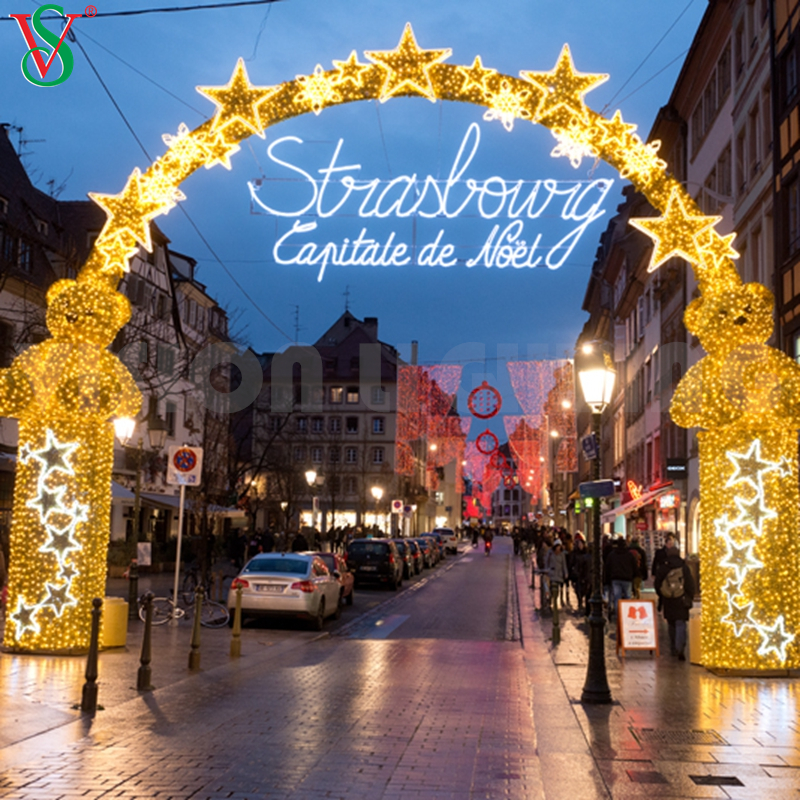
Long stretches of road can feel repetitive. You need immersive structures to break up the drive. Strategic placement of LED arch tunnel lights solves this problem. Tunnels surround vehicles completely, creating a massive sensory impact.
These structures act as "choke points" to organically slow down traffic. They also serve as your primary marketing assets. Tunnels generate the most social media shares. When evaluating tunnel hardware, scrutinize the frame stability. Aluminum frames resist rust and weigh less. Steel frames offer superior weight-bearing capacity but require anti-corrosion treatments. Always check pixel density. A sparse tunnel looks cheap. You want dense, modular panels designed for quick assembly and flat off-season storage.
You also need visual landmarks positioned strategically across open fields. Organizers utilize large-scale 3D motif light installations for this purpose. These might include giant glowing ornaments, towering reindeer, or massive holiday gift boxes.
These anchors give passengers something specific to look at in the distance. When selecting motifs, evaluate their daytime aesthetic carefully. Does the structure look like an ugly wire skeleton when the sun is out? Premium motifs feature UV-resistant PVC netting or decorative garland. This ensures they look attractive to daytime park visitors. Additionally, verify their wind-load resistance. Massive surface areas catch strong winter gusts easily.
You must maintain immersion between your tunnels and giant motifs. Do not let cars drive through dark, unlit zones. Use filler lighting to connect the major attractions.
Wrap existing park trees using heavy-duty commercial stringers. Drape canopy lights across overhead branches. This ambient filler lighting keeps the magic alive. It ensures passengers never feel like they have exited the show prematurely.
Winter weather aggressively destroys inferior equipment. Freezing rain, heavy snow, and high winds will test every connection point. You must treat these installations as robust commercial infrastructure.
Do not trust vague terms like "water-resistant". Demand specific Ingress Protection (IP) ratings.
IP65 should be your absolute minimum baseline. An IP65 rating means the fixture withstands low-pressure water jets from any direction. It survives heavy rain. However, IP65 is not sufficient for everything. You must demand IP67 ratings for ground-level connections. IP67 gear survives temporary submersion. Melting snow often creates deep puddles around power supplies. If a ground-level transformer lacks an IP67 rating, standing water will short out the entire sector.
You will run miles of high-voltage cabling. Never lay unprotected cables across active vehicle paths. A passing SUV will crush a standard wire instantly, creating a severe electrocution hazard.
Best Practice: Always use heavy-duty, drive-over cable protectors for road crossings. Select ramps rated for at least 10,000 pounds per axle.
Alternative Method: Use overhead rigging. Suspend cables securely between trees or poles. Ensure they hang at least 14 feet high to clear emergency vehicles.
Common Mistake: Leaving slack in cables near pedestrian walkways. Always pull cables taut and secure them using specialized ground staples.
Winter storms bring violent winds. Large thematic structures act like sails. We strongly advise using a skeptical tone regarding "freestanding" claims from cheap manufacturers. Physics dictates otherwise. A 15-foot tall ornament will tip over in a 40 mph gust unless properly anchored.
You must implement structural guy-wires for tall items. Anchor these wires using deep ground stakes or heavy concrete ballasts. Furthermore, account for snow load. Flat-topped structures accumulate heavy, wet snow. Ensure the metal framing can support hundreds of extra pounds without buckling.
Your event is only as reliable as your manufacturing partner. The market is flooded by traders disguising consumer-grade lights as commercial products. You must vet vendors ruthlessly.
Learn how to spot repackaged retail gear. Retail lights use thin 22-gauge wire. Commercial strings use robust 18-gauge or 20-gauge wire. Retail products rely on flimsy plastic controllers. Commercial products feature sealed metal enclosures.
Demand official stress-test documentation. Ask for UL (Underwriters Laboratories) or CE certifications. These listings prove independent labs tested the equipment for fire and electrical safety. If a vendor cannot produce these certificates, immediately walk away.
Vendor Evaluation Checklist
Evaluation Criteria | Consumer-Grade Warning Signs | Commercial-Grade Standards |
|---|---|---|
Wire Thickness | 22-gauge or thinner | 18-gauge or 20-gauge |
Weather Rating | Unrated or "Water Resistant" | IP65 (Displays) / IP67 (Ground Power) |
Safety Certification | None available | UL, ETL, or CE Listed |
Frame Material | Thin hollow plastic or untreated iron | Powder-coated aluminum or treated steel |
Hardware breaks. You need an ironclad warranty. A viable commercial vendor must offer multi-year warranties covering both metal frames and LED diodes. Expect at least a two-to-three season guarantee.
Crucially, assess their replacement parts policy. Avoid vendors requiring full-unit replacements for single-pixel failures. If one diode dies in a tunnel panel, you should only have to swap a small modular string. You should not have to replace a massive $500 panel. Ensure the vendor stocks spare parts domestically for rapid shipping during your busy season.
Do not wait until September to order displays. Manufacturing custom commercial structures takes time. Navigating logistics takes even longer.
Procuring large-scale commercial displays requires a strict 4- to 6-month planning runway. Overseas purchases must cross oceans via container ships. They must also clear unpredictable customs checkpoints. Domestic warehousing options offer faster shipping but usually carry higher price tags. Finalize your route maps and sign purchase orders by June to ensure timely October delivery.
A profitable seasonal event demands rigorous planning. You must treat your lights as critical commercial infrastructure, rather than disposable seasonal decor. By prioritizing IP-rated weatherproofing, robust power distribution, and modular RGB technology, you protect your park from catastrophic mid-season failures.
Your next steps require immediate action. First, establish your exact route map and calculate maximum vehicle throughput. Next, perform a comprehensive audit of your park's electrical capacity. Finally, begin your vendor consultations at least two quarters before your target launch date to secure inventory.
Do not leave your winter revenue to chance. Contact our commercial lighting design team today. We will audit your park's layout and provide a structured, reliable equipment proposal.
A: Power requirements vary wildly based on density. A modern 1-mile route utilizing highly efficient LED systems generally draws between 200 and 400 amps total. However, adding dense RGB tunnels or massive animated motifs pushes this higher. You must conduct a localized power audit. Map your desired layout first, then calculate the combined wattage to determine if grid power suffices or generators are necessary.
A: Yes, but only when engineered correctly. Large tunnels catch significant wind. You cannot leave them freestanding in open fields. Safety requires structural guy-wires attached to deep ground anchors. If ground staking is impossible, you must use heavy weighted ballasts (like water barrels or concrete blocks). Always request specific wind-rated engineering documents from your manufacturer.
A: We strongly advise against it. Prolonged summer sun causes severe UV degradation to acrylic elements, PVC netting, and cable jackets. While commercial frames resist rust, baking them in summer heat dramatically reduces the lifespan of the diodes. We recommend total off-season breakdown and dry indoor storage to maximize your return on investment and extend the display's usable life.
A: You should demand a minimum warranty of two to three seasons. Acceptable warranties fully cover manufacturer defects, diode failures, and controller malfunctions. They should also guarantee the structural integrity of metal framing against failed welds. Ensure the agreement clearly outlines a rapid parts-replacement process so you are not left waiting weeks for spares during peak event season.


