
- Home
- Products
- About Us
- Custom Services
- Solutions
- Resources
- News
- Contact
Views: 0 Author: Site Editor Publish Time: 2026-06-23 Origin: Site


Every year, retail spaces transform their environments to captivate holiday shoppers. You want to convert seasonal foot traffic into extended dwell time. We know festive atmospheres directly support higher tenant revenue. Shoppers naturally linger longer in visually engaging environments. They explore more sections of your property. Treating commercial displays like residential projects poses major risks. You might face strict code violations and frustrating mid-season failures. Inflated energy consumption can also overwhelm your infrastructure. Retail properties demand robust, carefully planned solutions.
To avoid these pitfalls, detailed planning remains essential. This guide serves as your procurement and implementation roadmap. Facility directors and retail marketing managers will learn how to evaluate large-scale festive lighting. You will discover how to source and deploy these installations safely. We will explore proven methods to elevate your property aesthetics without compromising structural integrity. Careful preparation prevents technical failures during peak shopping weeks. Read on to build a memorable holiday experience for every visitor.
Strategic commercial lighting requires aligning visual impact with structural limits and power capacities before purchasing.
Commercial-grade hardware (IP65+ ratings, coaxial connections) is non-negotiable for multi-season ROI and public safety.
Mixing traditional string lights with high-impact focal points (like a 3D motif light) optimizes budget while creating necessary photo opportunities.
Vendor evaluation must prioritize lead times, UL/CE compliance, and post-season storage or maintenance support.
Facilities managers cannot evaluate decorations on aesthetics alone. You must tie lighting strategies to specific business outcomes. Evening foot traffic often dips in traditional retail environments. Captivating displays draw shoppers back after dark.
Consider these primary success metrics when planning your strategy:
Increased evening footfall: Track the percentage of visitors arriving after sunset.
Social media engagement: Monitor user-generated content and location tags across social platforms.
Tenant participation: Measure how many storefronts complement the primary plaza decor.
Extended dwell time: Analyze parking duration data during the holiday season.
You must compare purchasing versus leasing displays. Assess this choice over a three-to-five-year lifecycle. Purchasing gives you complete control over your asset inventory. It allows you to customize exact specifications. Leasing provides flexibility to refresh designs annually without storage burdens. Determine your warehouse capacities before making this decision. Think about long-term maintenance requirements. Both models require a clear understanding of component durability. Ensure you evaluate the physical space needed to house large fixtures off-season.
Successful shopping mall Christmas lights require careful orchestration. You cannot rush large-scale installations. Plan your strategy in the second quarter. This timing accounts for manufacturing lead times and complex shipping logistics. Late planning limits your options to leftover stock.
Follow this proven deployment timeline:
March to April: Finalize creative concepts and secure management approvals.
May to June: Select vendors and place equipment orders.
August to September: Receive shipments and conduct quality control testing.
October: Schedule rigging contractors and map power distribution.
Early November: Execute nighttime installations to prevent disrupting shoppers.
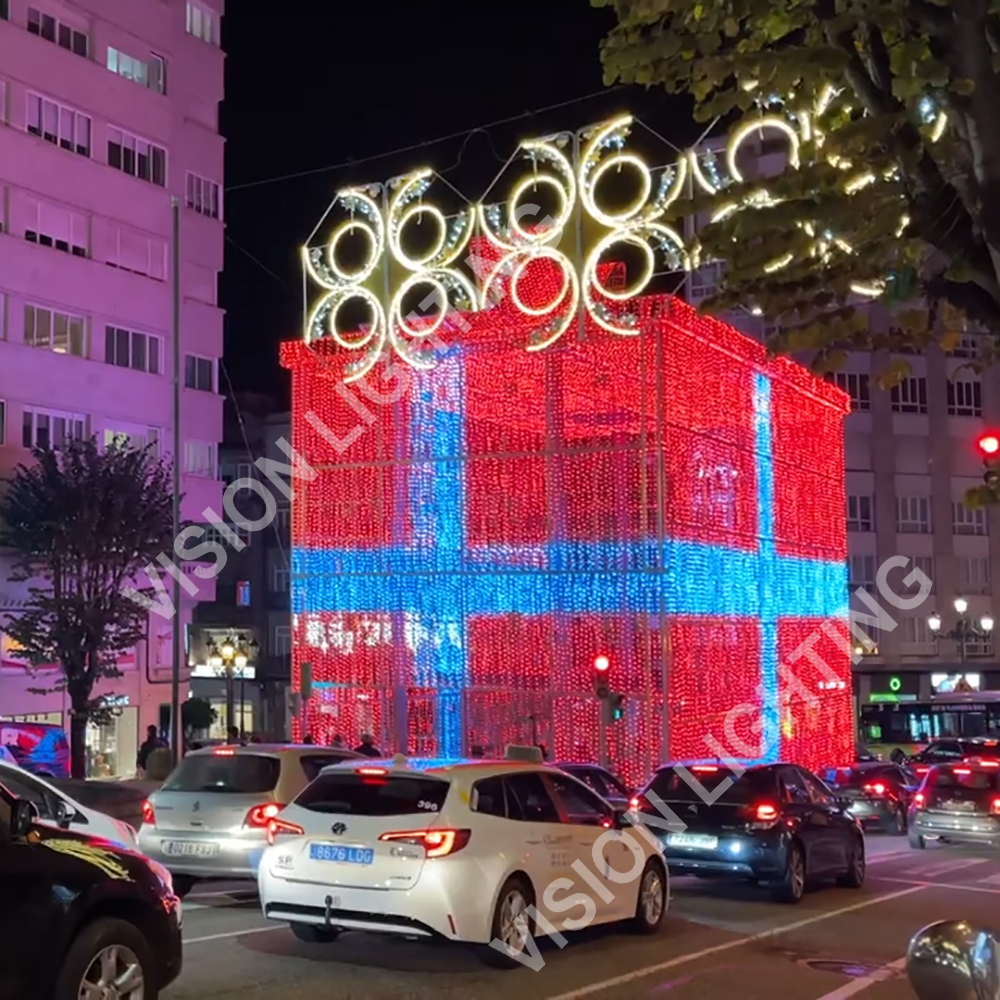
Exterior lighting forms your critical first impression. Draw visitors from street level and parking perimeters. Select robust string lights for trees and shrubs. Canopy drops add vertical interest to building facades. Ensure exterior lights feature UV-resistant casings. You want to prevent sun damage during daytime hours. Map local wind loads carefully. High winds can tear down improperly secured facade elements.
Indoor spaces offer massive vertical potential. Hanging oversized displays requires rigorous safety checks. Assess hanging weights carefully before confirming any design. You must meet strict structural rigging requirements. Work directly with structural engineers to confirm ceiling load limits. Aerial elements create visual anchors for multi-level shopping centers. They pull the visitor's eye upward and encourage exploration of upper floors. Never guess your ceiling capacities.
Ground-level installations encourage physical interaction. Modern shoppers seek out memorable photo opportunities. We recommend utilizing a giant 3D motif light to anchor main plazas. Walk-through ornaments and giant reindeer create immersive environments. These large pieces become signature destinations. Families will return annually to photograph their children inside them. Position these focal points in wide areas to accommodate crowd gathering.
You often find empty corners or long corridors requiring subtle festive touches. Modular components fill these gaps effortlessly. Consider using varied sizes of LED Christmas gift box lights. They serve as scalable, easy-to-deploy fillers. Group them near VIP lounges or Santa photo zones. They look spectacular and require minimal setup time. You can easily reposition them if foot traffic patterns change during the season. Modular designs adapt rapidly to your spatial needs.
Outdoor plaza displays face harsh winter climates. They require IP65 or IP67 ratings for reliable performance. You court failure if you settle for IP44 alternatives. Water intrusion destroys electrical components quickly. Ice accumulation and heavy winds test structural integrity constantly. IP65 ratings ensure protection against low-pressure water jets. IP67 adds temporary immersion protection. Do not compromise on these weatherproofing standards for exterior zones.
Safety regulations demand strict compliance. Commercial fire codes dictate electrical standards across public venues. You must secure UL, ETL, or CE certifications. Insurance liability policies mandate these safety marks. Uncertified equipment poses severe fire risks. We strongly advise inspecting certificates for every component. Request physical documentation from your supplier. Keep these records accessible for fire marshal inspections.
You must differentiate true commercial Christmas decoration lights from retail-grade alternatives. Retail-grade hardware degrades rapidly under continuous use. Professional displays feature thicker 20 AWG wire. They utilize watertight coaxial connectors. These connections prevent moisture ingress completely. Molded bulbs prevent water from reaching the socket base. Standard plug connections separate easily under tension. Coaxial connections thread together securely.
Modern surface-mounted diode (SMD) LEDs outperform legacy lighting. They offer massive power draw reductions. Thermal output decreases significantly as well. This efficiency prevents overloaded circuits. Cold-weather performance improves drastically with modern LEDs. They remain vibrant even in sub-zero temperatures. You reduce grid strain while maximizing brightness.
Feature | Retail-Grade Lights | Commercial-Grade Lights |
|---|---|---|
Wire Gauge | 22 AWG (Thin, fragile) | 20 AWG (Thick, durable) |
Weather Rating | IP44 (Splash resistant only) | IP65 / IP67 (Jet and immersion proof) |
Connections | Standard push-plugs | Watertight threaded coaxial |
Bulb Construction | Removable (Prone to rust) | Molded (Sealed against moisture) |
Planning your electrical capacity prevents disastrous blackouts. You must map available power drops across the property. Calculate the maximum amperage for every display section. Avoid tripping breakers during peak operational hours. Keep continuous load limits below 80 percent of the circuit capacity. Use heavy-duty, outdoor-rated extension cables safely tucked away. Cover all ground cables with ADA-compliant ramps. Prevent trip hazards in high-traffic pedestrian zones.
Massive displays demand professional handling. Partner with licensed riggers for complex setups. Use appropriate lift equipment like scissor lifts and articulating booms. High-elevation installations carry significant physical risks. Perform all heavy lifting after operational hours. You cannot disrupt mall traffic or endanger pedestrians. Secure necessary permits well in advance. Brief your security teams on the installation schedule to ensure seamless access for contractors.
January arrives and the season ends. Proper dismantling preserves your asset lifespan. Plan the teardown process just as rigorously as the setup. Do not let crews rush the removal. Careless pulling damages delicate wiring. Develop comprehensive labeling systems for every cord and bracket. Document exactly where each element belongs.
Follow these teardown best practices:
Photograph all complex connections before disconnecting them.
Coil wires loosely to prevent internal copper breakage.
Clean dirt and debris from frames before storage.
Use breathable, moisture-resistant storage containers.
Secure climate-controlled storage to prevent wire degradation. Moisture and extreme heat destroy components during the off-season. Rodents often chew through unprotected cables. Protect your assets diligently to ensure flawless operation next season.
You must choose between custom designs and pre-fabricated units. Bespoke designs tailor specifically to your mall branding. They integrate perfectly with your architectural elements. Custom pieces require longer manufacturing windows. Pre-fabricated commercial components ship much faster. They offer reliable performance straight off the shelf. Consider mixing both approaches. Custom centerpieces pair well with standard modular fillers. This hybrid strategy balances uniqueness with practical logistics.
Do not accept vendor claims blindly. Request detailed specification sheets for every item. Demand robust warranty documentation. Warranties must explicitly cover continuous commercial runtimes. Many consumer warranties void immediately upon commercial use. Ask for references from similar-sized retail properties. Speak directly to past clients about reliability and communication. Ask them how the vendor handled emergency failures. Real-world performance matters more than showroom aesthetics.
Component failures happen eventually. Ensure your vendor provides standardized, replaceable parts. You need access to individual LED nodes. Standardized power supplies remain crucial. You want to avoid scrapping entire displays due to minor issues. Good vendors offer clear service-level agreements for replacement parts. They maintain domestic stock for rapid shipping during November and December. Question your vendor on their exact support procedures before signing any contract.
Evaluation Criteria | Importance Weight | Minimum Acceptable Standard |
|---|---|---|
Safety Certifications | Critical | Valid UL, ETL, or CE documentation |
Component Durability | High | IP65+ rating, Coaxial connections |
Parts Availability | High | Guaranteed modular replacement stock |
Lead Times | Medium | Delivery minimum 4 weeks prior to install |
Let us review the path to holiday display success. You started by aligning strategy to measurable foot-traffic goals. We evaluated indoor and outdoor formats to maximize visual impact. We established rigorous hardware standards to ensure safety. Finally, you mapped out installation logistics and strict vendor selection criteria. Your highest return comes from careful planning.
Treat commercial holiday lighting as a multi-year infrastructure investment. Do not view these displays as annual disposable expenses. Quality components deliver exceptional experiences season after season. Prioritize IP ratings, wire thickness, and reliable rigging protocols.
Take action now. Initiate your property audit today. Assess your current power infrastructure and structural limits. Begin requesting vendor quotes before the third quarter. Secure your preferred designs early. Book your installation windows before top riggers fill their schedules. Proper preparation guarantees a stunning, problem-free holiday season for your facility.
A: High-quality commercial holiday lights typically last between three to five years. Multi-season longevity depends heavily on your local climate. It also relies on your storage practices. Using UV-resistant casings and IP65-rated connections extends lifespan significantly. Always store components in dry, climate-controlled environments.
A: Power consumption varies by size and design. Modern commercial SMD LEDs operate with high efficiency. They draw a fraction of the power required by legacy incandescent bulbs. Always request specific power-draw documentation per unit. This data allows accurate load calculations for your facility circuits.
A: You must never use indoor-rated displays outside. Outdoor environments demand IP65 or IP67 ratings to withstand moisture and freezing temperatures. Indoor units typically carry IP44 ratings or lower. Using them outdoors poses severe safety risks and guarantees rapid hardware failure.
A: You should order custom displays four to six months prior to installation. Manufacturers require significant lead times for bespoke fabrication. Global shipping logistics often add weeks to delivery schedules. Finalize your orders by June to ensure a smooth, stress-free November installation.


