
- Home
- Products
- About Us
- Custom Services
- Solutions
- Resources
- News
- Contact
Views: 0 Author: Site Editor Publish Time: 2026-08-26 Origin: Site


Commercial environments require dynamic visual focal points. They must scale effectively while meeting strict safety and durability standards. Today, facility managers and designers need impactful visual assets. The transition from traditional seasonal decor to experiential design is profound. It has made illuminated installations a year-round asset for hospitality, retail, and public spaces. They transform ordinary areas into highly memorable destinations. Modern shoppers and guests expect immersive environments constantly. Planners face immense pressure to deliver stunning visuals safely. You need reliable solutions to attract and retain foot traffic. This guide outlines the structural, electrical, and design criteria necessary to successfully evaluate and deploy commercial-grade illuminated trees. You will discover practical strategies for spatial design and hazard mitigation. We also explore essential steps for shortlisting capable vendors to execute your creative vision flawlessly.
Facility managers constantly face a difficult balancing act. They struggle to deploy high-impact aesthetic installations affordably. Ongoing labor and maintenance costs consume tight budgets quickly. Traditional physical decor requires constant manual swapping. Upgrading your shopping mall decoration lights solves this persistent dilemma. Modern illuminated installations offer exceptional experiential returns. Large-scale decorative trees act as a powerful foot traffic magnet. Visitors naturally gravitate toward brilliant, glowing structures. They stop to admire the intricate illuminated blossoms. This behavior supports extended dwell time significantly. Retail centers thrive when customers linger longer. Hospitality venues see increased food and beverage sales. Extended stays translate directly into higher revenue opportunities.
The Instagram factor drives massive organic reach. A luminescent canopy encourages spontaneous user-generated content. Shoppers love taking group photos under glowing branches. They immediately share these images on social networks. Location tagging acts as free digital advertising. This visual appeal builds your venue's online reputation effortlessly. You harness the power of word-of-mouth marketing digitally. It provides a massive return on a single visual asset.
Seasonal agility provides another massive operational advantage. Programmable lighting modes transition a single asset effortlessly. You can utilize static, fade, or twinkle settings. You adjust the color palette for different holidays. Switch to warm white for winter celebrations. Use vibrant pinks for spring festival events. You accomplish all this without replacing physical decor. This agility eliminates massive seasonal labor costs. Storage requirements drop because you use the same structure year-round.
An LED cherry blossom tree transforms plain commercial zones dramatically. Let us explore proven spatial design approaches to maximize visual impact.
Indoor atriums and grand lobbies present unique architectural challenges. They often feature massive vertical dead space. Designers utilize towering profiles to draw the eye upward. Trees ranging from 10ft to 15ft fill these voids perfectly. They create a stunning visual anchor upon entry. Contrast these fixtures against natural architectural materials. Heavy wood, raw concrete, and sleek glass dominate modern lobbies. The soft, ambient glow of pink LEDs softens these hard edges. Warm-white LEDs create a highly inviting, luxurious atmosphere. The interplay between industrial architecture and glowing flora is striking. It leaves a lasting first impression on your guests.
Hospitality patios and rooftop bars require intimate zoning. You can create immersive dining canopies easily. Cluster multiple tall trees together over patio tables. The intersecting branches form a magical glowing ceiling. Guests absolutely love eating under this luminescent canopy. You can also establish clear visual boundaries. Mid-sized illuminated trees excel at this specific task. They section off VIP areas or private cabanas elegantly. They replace boring velvet ropes with glowing, sculptural art.
Event perimeters and large commercial plazas demand clear wayfinding. Planners must direct heavy foot traffic safely. Deploy symmetrical tree placements to frame main entrances. They act as glowing beacons for arriving guests. Guide pedestrian flow strategically using illuminated markers. People naturally walk toward bright, attractive structures. They help visitors navigate massive, confusing spaces effortlessly.
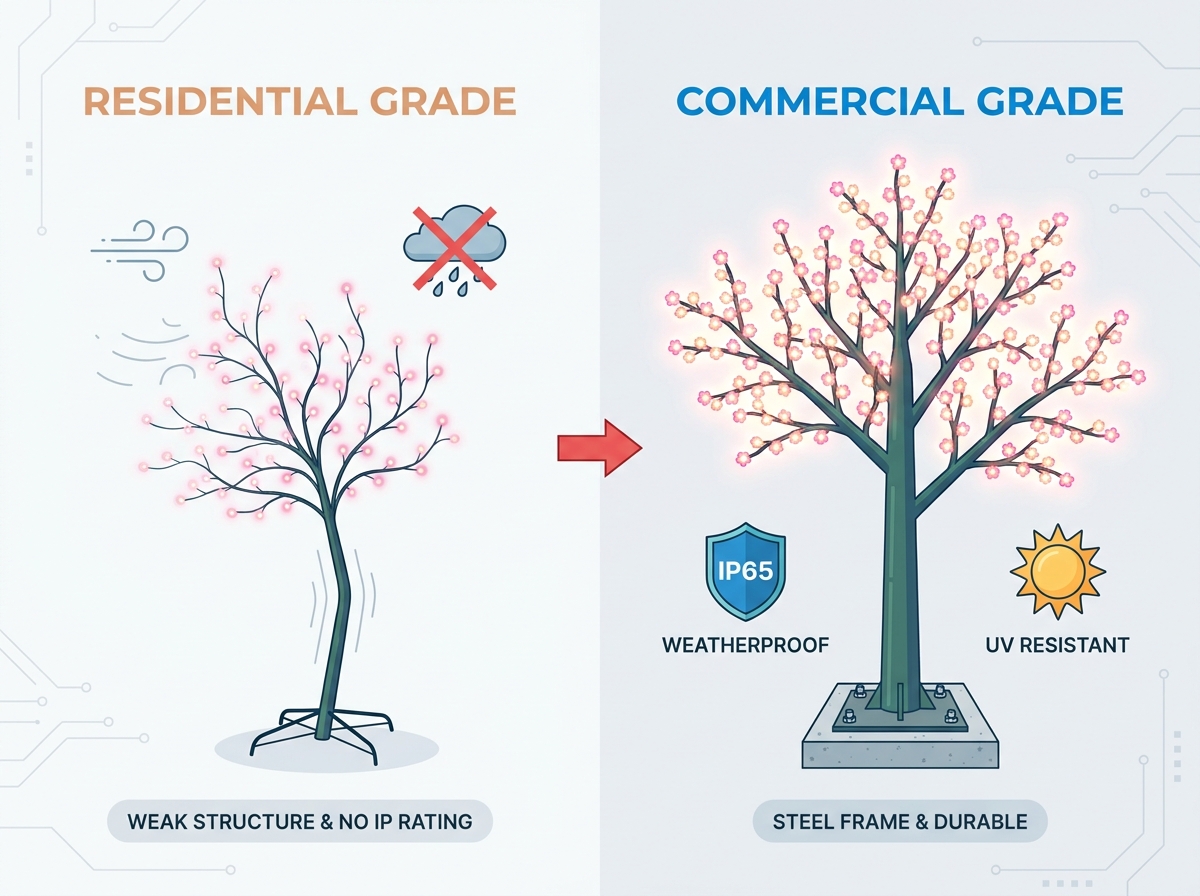
Commercial buyers must demand strict electrical safety compliance. Do not settle for unverified residential products. Require UL-listed or CE-certified transformers for every installation. Low-voltage operation is absolutely non-negotiable for public safety. Systems typically running on 24V minimize severe electrocution risks. Overload protection safeguards the venue's broader electrical grid. It prevents catastrophic failures during power surges. You protect your guests and your property simultaneously.
Weatherproofing dictates the long-term survival of outdoor units. Demand IP65 or IP67 ratings for any outdoor landscape tree light. This certification ensures complete protection against fine dust. It also guarantees resistance to heavy, sustained rain. Evaluate the blossom materials very carefully. Demand UV-resistant PVC or resin for all petals. Sunlight destroys cheap plastics rapidly. UV degradation causes severe sun-fading over multi-year deployments. UV-resistant materials ensure the colors remain vibrant indefinitely.
Structural integrity separates professional assets from temporary props. Differentiate between flimsy wire trunks and robust frames. Commercial-grade frames utilize heavy steel pipe construction. Manufacturers wrap this steel in high-density, textured resin. This resin mimics real bark while protecting the metal. It withstands heavy physical impacts from passing crowds. It also survives severe weather events safely.
Assess LED quality and reparability before signing contracts. The internal diodes should rate for at least 50,000 hours. You must ask whether individual branches are independently replaceable. Light strands will eventually fail after years of use. A modular design allows you to swap broken branches quickly. You avoid discarding a massive, expensive trunk. A true LED artificial tree guarantees long-term serviceability.
Follow these essential evaluation steps:
Comparison of Tree Grades
| Feature | Residential Grade | Commercial Grade |
|---|---|---|
| Frame Material | Thin wire or brittle plastic | Heavy steel pipe wrapped in dense resin |
| Voltage | 110V/220V direct current | 24V low-voltage protected transformer |
| Weatherproofing | IP44 (basic splash-proof) | IP65/IP67 (heavy rain and dust proof) |
| Reparability | Integrated wiring; entire unit fails | Modular branches; individually replaceable |
Outdoor deployment introduces significant physical risks. Tipping remains the primary danger for tall installations. Wind loads exert massive force on a dense artificial canopy. Proper anchoring is critical for absolute public safety. Hardscape surfaces require heavy steel base plates. Installers must use concrete expansion bolts for maximum security. You drill directly into the pavement to lock the base. Some venues cannot permit permanent ground drilling. You can utilize weighted decorative planters instead. These heavy planters hide massive concrete ballasts perfectly. They secure the structure while maintaining a clean aesthetic.
Cable management ensures strict ADA compliance. You must conceal all electrical drops meticulously. Tripping hazards cause severe liability issues in high-traffic zones. Route cables through protective ground conduits whenever possible. Ensure branch clearance strictly meets local accessibility codes. Pedestrian walkways require specific overhead height clearances. Low-hanging branches endanger visually impaired guests. Always maintain a clear, unobstructed path of travel for everyone.
Set highly realistic expectations for labor and assembly. These are heavy, commercial-grade architectural elements. They often arrive in large, heavy modular pieces. You will handle a massive trunk and dozens of numbered branches. Assembly requires specialized mechanical lift equipment. Scissor lifts or boom lifts are usually mandatory for taller units. A trained crew of two to three people is necessary. They must work together to hoist and secure the heavy canopy. This is never a quick, single-person weekend job.
Scrutinize the fine print of any warranty closely. A legitimate commercial warranty separates coverage types clearly. The steel structural frame usually carries a multi-year guarantee. The LED electrical components often have a shorter window. Understand these coverage distinctions before issuing a purchase order. Ask how the vendor handles component replacements under warranty. You need a partner who ships replacement branches quickly.
Vet suppliers rigorously for their customization capabilities. The best vendors modify specifications to suit your exact needs. They adjust overall height and canopy width effortlessly. They can increase branch density for a fuller look. They offer highly specific LED color temperatures. You might need 3000K warm white or 4000K natural white. These targeted tweaks ensure the product matches brand guidelines perfectly. Standard off-the-shelf options rarely fit custom architectural spaces.
Factor shipping and storage logistics into your procurement plan. Heavy commercial boxes require specialized LTL freight shipping. Freight costs add significant amounts to your initial budget. Plan your off-season storage space very carefully. You must protect modular branches from heavy crushing. Specialized storage racking prevents resin damage during the summer months. Poor storage destroys expensive lighting assets quickly.
Sourcing an LED artificial tree for a commercial space is complex. It requires looking far past the initial aesthetic appeal. Planners must evaluate structural safety and electrical compliance thoroughly. Long-term durability determines the true value of your investment. A beautiful tree is worthless if it fails during the first storm. It becomes a liability rather than an asset.
Prioritize vendors who communicate transparently. They should gladly provide detailed technical spec sheets. They must show certified IP ratings for all outdoor units. Clear, engineered anchoring instructions are absolutely mandatory. Avoid suppliers competing solely on rock-bottom prices. The cheapest option inevitably fails during extreme weather. Focus your budget on verifiable commercial-grade construction. You will secure a stunning, safe, and enduring visual asset for your property.
A: Energy efficiency is a massive operational advantage. A typical 10-foot tree consumes roughly 150 to 200 watts. Low-voltage 24V systems minimize power waste significantly. They convert energy efficiently into bright lumens. This allows large installations without overloading your venue's electrical grid. You save significantly on utility bills.
A: Yes, provided they feature true commercial specifications. Seasonal IP44 decor degrades rapidly outside. Year-round installations strictly require IP65 or IP67 ratings. You must also ensure the petals utilize UV-resistant materials. This critical feature prevents the sun from bleaching vibrant colors over the harsh summer months.
A: Routine maintenance requires very gentle techniques. Commercial cleaning crews should use compressed air. It removes surface dust safely and quickly. For sticky residue or heavy outdoor grime, utilize gentle low-pressure washing. Avoid high-pressure power washers entirely. They can easily strip the petals or force water into sealed electrical joints.
A: Professional-grade trees utilize a highly modular branch design. If a specific section fails, you unplug and replace only that branch. This prevents discarding the entire fixture. Cheaper residential trees feature integrated wiring limits. When their lights burn out, the whole unit often becomes completely useless.


