
- Home
- Products
- About Us
- Custom Services
- Solutions
- Resources
- News
- Contact
Views: 0 Author: Site Editor Publish Time: 2026-08-31 Origin: Site


Commercial landscaping has evolved dramatically over recent years. We are moving far away from basic floodlights toward immersive, experiential installations. Visitors now expect dynamic, engaging environments to drive nighttime foot traffic and create shareable moments. Balancing daytime aesthetic appeal presents a distinct challenge for park designers. Technical reliability and striking visual impact at night require rigorous planning. You must seamlessly blend electronics into natural public spaces safely. This article provides a highly practical framework for selecting commercial-grade illuminated flora. We focus specifically on justifying the upgrade to addressable, programmable displays. You will learn how to properly evaluate hardware components before purchasing. We also cover essential strategies to manage power distribution effectively. By understanding these core principles, you can transform standard pathways into captivating nocturnal attractions.
Parks and botanical gardens constantly look to extend operational hours. They need reliable ways to increase winter and evening revenue. However, they must achieve this without disrupting the natural environment. Strategic lighting transforms dormant spaces into profitable nighttime attractions.
We often see landscapes struggle to maintain high attendance after sunset. Traditional lighting simply illuminates a path. In contrast, integrating modern outdoor garden decoration lights creates an immersive destination. When you evaluate the return on investment for these installations, success relies on several distinct criteria:
Landscape architects are actively shifting toward faux-flora. They integrate illuminated artificial elements directly alongside natural planting beds. High-quality acrylic or silicone flowers look completely natural during the daytime. At night, they bloom into vibrant light sources. This dual-purpose design maximizes visual appeal around the clock.
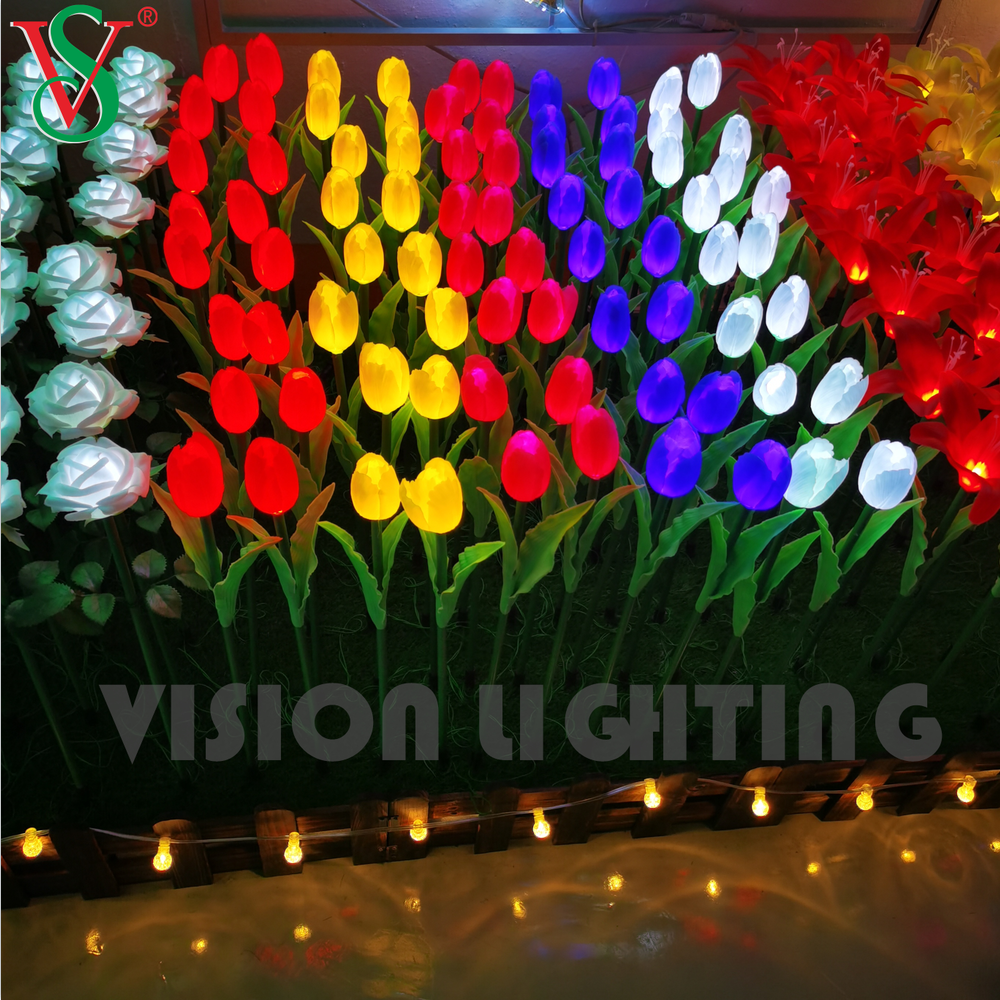
Understanding the technical mechanisms behind different fixtures is crucial. You must match the hardware to your specific project goals. We generally categorize these displays into two distinct systems.
Standard systems operate on a relatively simple mechanism. Entire clusters or individual flowers display a single color simultaneously. Sometimes, they cycle through colors uniformly. They rely on basic circuitry to emit light.
These advanced systems operate very differently from standard models. Each flower—or even each LED node within a flower—contains an integrated circuit (IC) chip. This chip allows independent color and brightness control via SPI or DMX512 protocols.
| Feature | Standard / Basic RGB | Addressable Pixel RGB |
|---|---|---|
| Control Mechanism | Uniform color changes across all connected units. | Independent IC chips for per-node control. |
| Ideal Application | Pathway lining, basic ambient illumination. | Music-synchronized shows, interactive displays. |
| Installation Complexity | Low (Plug-and-play). | High (Requires decoders, controllers, mapping). |
| Visual Impact | Static or uniform fading. | Dynamic chases, custom patterns, infinite variety. |
You must evaluate fixtures rigorously before committing to a large installation. Selecting the right LED artificial flower lights requires examining three core technical areas.
Waterproofing is an absolute necessity for commercial landscapes. Demand an IP65 rating for standard outdoor use. If your installation areas are prone to flooding or heavy snow, mandate IP67. Ensure all connectors share this exact rating. Do not just check the flower heads. A system will fail if its cabling succumbs to moisture.
Material degradation is another common pitfall. Petals are often made from PVC, silicone, or fabric. They must be UV-treated at the manufacturing level. Untreated materials will suffer yellowing and brittleness from intense daytime sun exposure. We highly recommend verifying the UV resistance standards directly with your manufacturer.
Consistent light output separates professional installations from amateur setups. You must assess lumen output carefully. Ask your supplier about their binning consistency processes. Poor LED binning results in mismatched color temperatures across large batches. A white petal should look identical to its neighbor. Color variations look messy and undermine the aesthetic.
Physical durability matters just as much as electronic reliability. Stems should utilize rust-proof materials like stainless steel or coated aluminum. They must also offer specific flexibility. A rigid stem will snap during high winds. A properly designed flexible stem mimics natural wind movement beautifully. This structural balance ensures true longevity.
Theoretical designs often clash with physical installation realities. You must plan for practical environmental constraints before breaking ground.
Voltage drop is a harsh reality in low-voltage outdoor installations. Whether you run 12V or 24V systems, power fades over long park pathways. As voltage drops, LEDs lose brightness or shift in color entirely. You must calculate wire gauge requirements meticulously. Inject power at regular intervals to maintain consistent luminosity across expansive landscapes.
Advanced setups demand careful infrastructure planning. Pixel systems require strategically placed power supplies and signal decoders throughout the park. You cannot simply daisy-chain thousands of addressable nodes endlessly.
You will also face a software learning curve. Mapping pixels accurately takes time. Utilizing industry-standard software like Madrix or Resolume allows for incredible custom programming. We suggest hiring an experienced lighting programmer for initial setups. They will build robust templates you can trigger easily later.
Public spaces hide numerous installation hazards. Soil acidity severely affects buried cables over time. Rodent damage to wiring remains a constant threat in parks. We strongly advocate for robust conduit systems. Enclosing primary data and power lines protects your investment from unseen environmental damage.
Procuring commercial hardware involves strict vetting. Never base decisions solely on aesthetic photographs.
You must look for verifiable compliance documentation. Request CE, RoHS, and UL/ETL certifications upfront. Pay special attention to the power adapters and primary cabling. The fixture itself matters, but high-voltage components carry the actual safety risks. Uncertified adapters frequently fail during extreme weather events.
Never purchase bulk inventory without field-testing a sample unit first. Subject the sample to rigorous scrutiny. Test for water ingress by spraying it forcefully. Leave it exposed to direct sunlight to monitor potential petal color fading. Measure the actual power draw to ensure it matches the provided spec sheet. This simple protocol prevents massive deployment disasters.
Prioritize suppliers offering modular replacements. Avoid sealed, disposable units entirely. If one flower head fails on a branch, you should only replace that specific head. Swapping an entire multi-stem branch wastes resources. A modular approach streamlines ongoing maintenance heavily.
Summarize the decision matrix carefully. Opt for basic, static models for budget-conscious ambient lighting along pathways. Invest in addressable pixel RGB displays if your primary goal is creating a ticketed, interactive nighttime attraction. The visual payoff justifies the complex setup.
Your next steps are clear and actionable. First, audit your existing power infrastructure to determine capacity. Next, draft your exact environmental requirements. Finally, request detailed technical spec sheets from shortlisted manufacturers. Careful planning today guarantees a breathtaking landscape tomorrow.
A: The internal LED diodes typically boast a lifespan of 30,000 to 50,000 hours. However, the physical degradation of the faux petals usually dictates the practical lifespan. Depending on daily UV exposure and extreme weather conditions, the silicone or fabric petals generally last 2 to 5 years before requiring cosmetic replacement.
A: This is usually impossible. Standard LEDs lack the internal IC chips necessary for independent addressing. You cannot simply add a new controller to a basic diode. Upgrading to a programmable, music-synchronized system necessitates a full hardware replacement of the light heads and their underlying data cabling.
A: Modern pixel systems utilize continuous-transmission signal LEDs. These sophisticated nodes feature backup data lines. If one flower fails, the signal bypasses the broken node, allowing the rest of the chain to function normally. Older models lacked this bypass feature, meaning one failure would break the entire sequence.


