
- Home
- Products
- About Us
- Custom Services
- Solutions
- Resources
- News
- Contact
Views: 0 Author: Site Editor Publish Time: 2026-06-27 Origin: Site


High-traffic public installations require more than off-the-shelf retail lighting. City squares demand commercial-grade durability, strict safety compliance, and reliable power management. A dark tree centerpiece or a blown electrical circuit ruins the holiday magic. It also damages public perception. Municipal planners, commercial property managers, and event coordinators face significant friction here. You must balance stunning visual impact with strict installation parameters and public liability concerns.
This guide provides a comprehensive blueprint. We cover specifying, sizing, and deploying commercial LED systems. You will learn how to choose components capable of withstanding severe winter conditions. We outline the technical requirements for rigging massive displays safely. Follow these steps to ensure a brilliant, dependable holiday setup. Proper planning allows you to deliver verifiable success for your community without facing mid-season equipment failures.
Commercial-grade wire (typically 18-gauge) and coaxial connections are non-negotiable for city square installations to prevent moisture ingress and electrical failure.
Accurate bulb density calculations depend on viewing distance; large public squares typically require C7 or C9 bulbs rather than standard mini lights.
Modern programmable RGB tree lights offer multi-year versatility but require specific DMX controller mapping and higher initial capital expenditure.
Installation protocols must prioritize wind load ratings and load-balancing across multiple electrical circuits.
You cannot deploy residential lights in public spaces. Retail strands use thin 22-gauge wire. This thin wire snaps under heavy ice accumulation or high wind conditions. The bulb sockets on retail strands remain unsealed. Capillary action draws rainwater and melted snow directly into these sockets. This moisture causes immediate electrical shorts. Furthermore, retail options use lower-quality plastics. Ultraviolet degradation destroys these plastics within weeks of outdoor exposure, turning wires brittle.
Public squares require commercial-grade durability. You must prioritize specific Ingress Protection (IP) ratings. Bulbs require a minimum IP65 rating to resist low-pressure water jets. Connectors need an IP67 rating to survive temporary submersion in freezing puddles. Commercial strands feature one-piece bulb construction. The plastic bulb cover merges seamlessly with the socket base. This design entirely prevents water accumulation inside the housing. Specifying commercial outdoor Christmas decoration lights protects your display against extreme weather.
Investing in commercial infrastructure changes your operational timeline. Standard retail options serve as single-season throwaways. Commercial lighting systems offer a reliable three-to-five-year operational lifespan. These robust systems drastically reduce emergency maintenance dispatches. You avoid sending expensive electrical crews out in freezing temperatures to find a single dead bulb. The robust 18-gauge wire resists stretching and breaking, ensuring your installation remains fully illuminated through the entire holiday season.
Visual scale matters immensely in large open spaces. A standard mini light disappears from fifty feet away. Selecting the correct bulb size ensures your display registers correctly for passing traffic and pedestrians. Large civic trees demand deliberate bulb choices to create impact.
Towering structural trees exceeding 30 feet require C9 bulbs. These large, faceted bulbs provide maximum luminosity. They stand out perfectly for long-distance visibility across massive civic plazas. Medium municipal trees ranging from 15 to 25 feet look best with C7 bulbs. The slightly smaller C7 bulb allows for higher density wrapping without overwhelming the tree branches. You should reserve 5mm wide-angle mini LEDs strictly for trunk wrapping or dense foliage infill. Mini LEDs add internal glow but fail to define primary silhouette lines on massive trees.
Bulb Type | Best Use Case | Tree Height Range | Recommended Spacing |
|---|---|---|---|
C9 | Long-distance visibility, canopy outlines | 30+ feet | 12 inches |
C7 | Medium density, elegant branch wraps | 15 - 25 feet | 8 to 12 inches |
5mm Mini | Trunk wrapping, dense infill | Any height (as accent) | 4 to 6 inches |
Procurement teams need baseline metrics to order enough materials. A reliable rule of thumb requires 100 to 150 bulbs per vertical foot for a dense, professional canopy wrap. Spacing configurations directly influence this math. We recommend 12-inch spacing for distant viewing scenarios. You save material while maintaining a striking profile. Conversely, select 6-inch spacing for pedestrian-heavy plazas. Close-up viewing demands tighter bulb density to avoid looking sparse. High-quality LED Christmas tree lights provide brilliant saturation even at wider spacing intervals.
Modern LEDs revolutionize power distribution for large displays. Legacy incandescent bulbs drew massive wattage, requiring dozens of individual circuits. LED lines draw a fraction of that energy. A standard C9 LED bulb uses less than one watt. You can run hundreds of feet of continuous lighting on a single 20-amp breaker. This exact amperage reduction drastically simplifies your power distribution grid. It minimizes the need for extra generator rentals or complex sub-panel installations in the park.
City squares present different environmental realities. Some feature towering, mature pine trees. Others feature flat concrete hardscapes. You must evaluate your structural canvas before specifying the lighting system.
Working with living trees requires specific techniques. Branch-wrapping follows the natural architecture of the tree. It highlights individual limbs and creates a stunning, three-dimensional effect. Canopy-draping simply lays light strings over the exterior foliage. Draping goes faster but looks less professional. Biological growth plays a massive role in live tree installations. If you intend to leave the lights installed year-round, you must account for trunk expansion. Wrap branches loosely. Leave strategic slack in the lines. Tight wires will girdle and kill tree branches as they expand during the spring growth cycle.
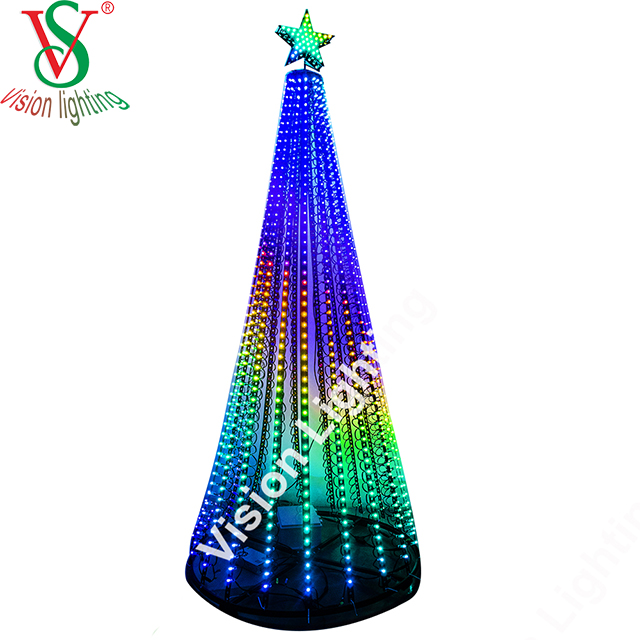
Many urban environments lack natural trees. A 3D Christmas tree motif light solves this problem. These structures utilize heavy-duty steel or aluminum frames. Manufacturers pre-attach the lighting to these frames at the factory.
You must evaluate these motif trees rigorously. Review the frame weight and modular stacking ability. Aluminum frames resist rust and weigh less, making crane assembly much easier. Wind load engineering certifications represent the most critical evaluation criteria. Public squares act as wind tunnels. The frame must withstand specific wind gusts without tipping. Motif trees excel in paved plazas. They allow for rapid, scheduled assembly. They also provide a perfectly predictable footprint, ensuring you do not block pedestrian right-of-ways or emergency vehicle access.
The visual direction of your installation impacts technical requirements. Traditional static displays operate differently than dynamic digital light shows. You must align your visual goals with your team's technical capabilities.
Static lighting represents the traditional, high-elegance approach. Warm white or solid colors deliver a timeless aesthetic. Static systems boast a significantly lower failure rate. They require no complex programming. Replacement remains straightforward; if a section goes dark, you simply swap the strand. These systems also require lower hardware costs. You do not need specialized data cables or networking routers to run static lines.
Dynamic displays capture public attention and dominate social media. Programmable RGB tree lights utilize pixel mapping. Each individual bulb acts as a distinct pixel. Software dictates the color and timing of every bulb.
This approach builds a strong business case for long-term installations. A single hardware deployment can cycle through multiple holiday themes. You can program autumn colors for Thanksgiving, red and green for Christmas, and glittering silver for New Year's Eve. You achieve distinct visual campaigns without hanging new lights.
However, implementation reality requires serious technical infrastructure. You must install dedicated DMX controllers. You need secure, weatherproof housing for the networking gear. Setup demands higher technical proficiency from your installation crew. When vetting vendors, always ask about the software ecosystem. Check if the RGB software is proprietary. Proprietary software creates vendor lock-in, forcing you to buy replacement parts exclusively from them. Open-standard protocols give you flexibility to source compatible hardware from various manufacturers over the years.
Aesthetically pleasing designs mean nothing if the electrical backbone fails. Safety compliance protects the public and prevents catastrophic fires. You must design your power distribution network with mathematical precision.
Never overload your breakers. Always implement the 80% rule for circuit loading. A standard 20-amp breaker should never carry more than 16 amps of continuous load. Calculate your maximum run lengths meticulously. Excessive lengths of wire cause voltage drop. Voltage drop starves the LED bulbs at the end of the line, causing them to dim or flicker. Larger wire gauges prevent this drop. An 18-gauge wire carries power much farther than a 22-gauge wire without degrading the signal or dimming the lights.
Physical safety requires as much attention as electrical safety. Frame-based motif trees demand heavy stabilization. Use rated guy-wires anchored to structural hard points. If ground anchors are impossible, utilize heavy ballast weights hidden inside the base of the frame. Pedestrian safety remains paramount. You must secure all electrical cords crossing walkways. Always use ADA-compliant cable protectors. These heavy rubber ramps prevent trip hazards and protect the cables from damage by wheelchairs, strollers, and municipal snowblowers.
The success of next year's display depends entirely on this year's teardown. Haphazard removal destroys equipment. Follow a strict standard operating procedure:
Label Every Run: Tag the start and end of every wire. Note exactly which branch or frame tier it belongs to.
Inspect Coaxial Seals: Check every connection point. Look for cracked O-rings or moisture damage inside the plug.
Coil Without Twisting: Use the over-under coiling method. This prevents the internal copper wires from snapping.
Climate-Controlled Storage: Store all equipment in a dry, climate-controlled facility. Extreme summer heat in metal shipping containers will melt wire insulation and ruin LED diodes.
Successful public installations rely on rigorous math and robust infrastructure, not just aesthetics. Proper power distribution, accurate sizing calculations, and commercial-grade seals determine the lifespan of your display. Retail lights fail in civic environments. Upgrading to one-piece LED construction and 18-gauge wiring guarantees a safer, more reliable holiday season.
Your next steps require site preparation. Audit your available power drops in the city square. Map out exactly how many dedicated 20-amp circuits you can access. Measure your physical installation footprint, noting pedestrian right-of-ways and wind exposure. Gathering this data ensures you receive accurate vendor quotes and avoid mid-installation surprises.
Do not leave your civic display to chance. Reach out to a certified commercial lighting specialist today. Request a thorough site consultation. You can also download technical specification sheets for IP-rated equipment or view galleries of successful municipal case studies to inspire your next project.
A: A 40-foot tree typically requires between 4,000 and 6,000 bulbs. This assumes you use the rule of thumb of 100 to 150 bulbs per vertical foot. Dense branch wrapping demands the higher end of this range, while a simple canopy drape uses fewer bulbs.
A: Yes, provided you use commercial-grade strands. However, you must monitor UV degradation. Plastic components eventually weaken under constant sunlight. If wrapped on live trees, you must loosen the strands annually to accommodate biological trunk expansion and prevent girdling.
A: Standard plugs easily pull apart and allow water ingress. Coaxial plugs feature a threaded, screw-together mechanism with internal rubber O-rings. They offer massive pull-strength, preventing wind from disconnecting them. They also provide superior weatherproofing by entirely sealing out moisture.
A: No. Most professional DMX controllers store the light show directly on local memory cards. You only need a network connection to upload new programming or make live adjustments. Once programmed, the local controller runs the show autonomously without live cloud streaming.


