
- Home
- Products
- About Us
- Custom Services
- Solutions
- Resources
- News
- Contact
Views: 0 Author: Site Editor Publish Time: 2026-07-01 Origin: Site


Activating large mall atrium spaces poses a significant challenge during the holiday season. Property managers need high-impact visuals to captivate visitors immediately. These displays must handle massive public interaction safely. Leaving vast vertical spaces empty represents a missed opportunity for shopper engagement. Commercial-grade holiday decor offers a scalable solution to this exact problem. They function as a high-return visual merchandising asset. We see them transform ordinary commercial spaces into magical winter destinations.
This guide explores essential design strategies for festive retail environments. We examine key technical criteria to evaluate carefully before your next purchase. You will discover practical implementation realities to guide your seasonal installations. B2B retail buyers and property managers will find actionable insights here. They can apply these strategies to maximize their holiday installation success.
Modern shopping centers often feature massive empty voids above center courts. Oversized gift box structures fill these areas beautifully. They draw the eye upward without blocking ground-level retail signage. Visitors experience a sense of awe when looking up. This strategy prevents sightline obstructions for crucial anchor tenants. You can scale these installations to fit any ceiling height perfectly.
Shoppers actively seek photogenic backdrops during the festive season. They want stunning photos to share online. Designing for user-generated content (UGC) is crucial today. A well-placed 3D motif light serves as an irresistible selfie station. When visitors post pictures online, they create free social proof for your property. This digital visibility drives organic foot traffic directly to your doors.
Engaging display zones encourage shoppers to stay much longer. Longer dwell time generally boosts retail and dining sales. However, planners must balance this attraction with necessary crowd flow. You cannot block primary walkways. We must maintain strict fire lane compliance at all times. Strategic placement keeps crowds moving safely while still offering photo opportunities.
Smart display designs allow you to reuse base structures year after year. You simply swap the exterior acrylic panels to refresh the theme. Updating the lighting sequences also transforms the visual appeal entirely. This modular approach keeps your seasonal displays feeling brand new. It prevents the decor from becoming stale or predictable for regular visitors.
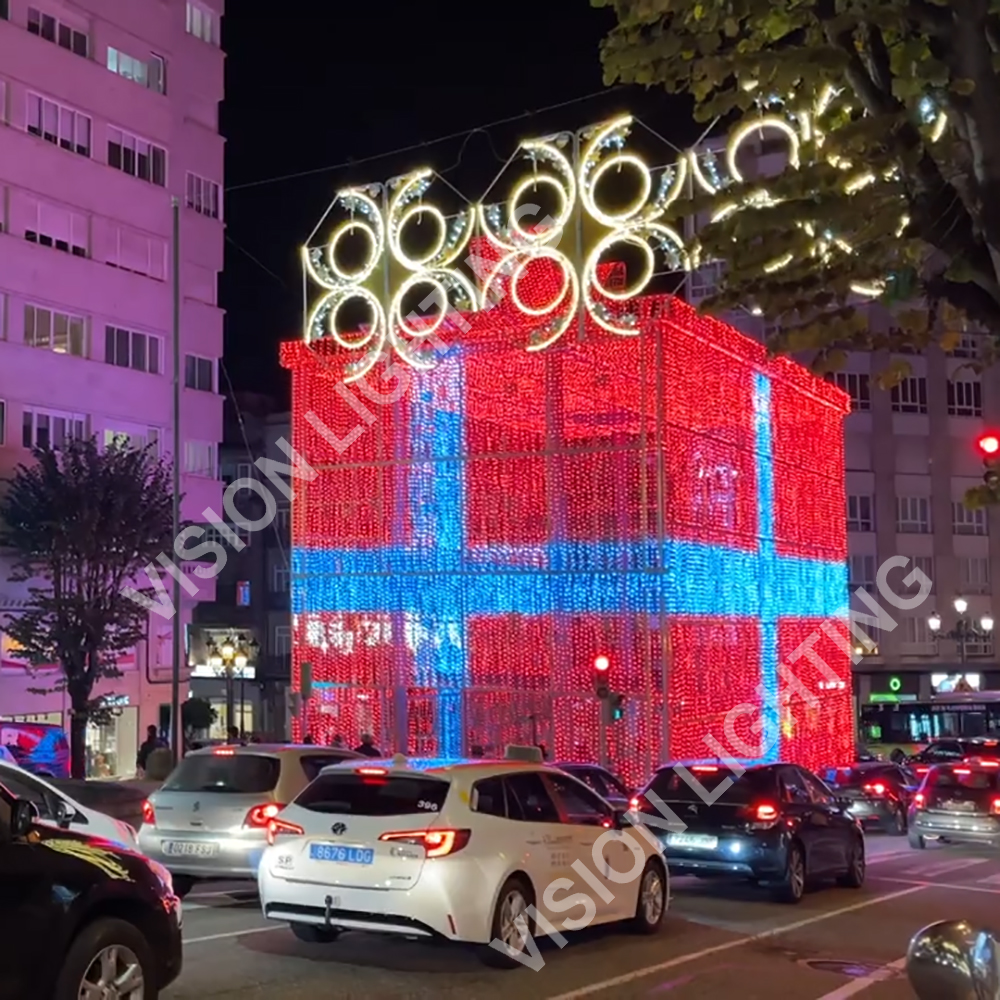
Shoppers love highly interactive holiday elements. Archway-style LED gift box lights allow them to walk right inside. This immerses families in the festive experience completely. Designing these requires reinforced steel framing for ultimate public safety. You must use low-voltage lighting at all human touchpoints. This ensures nobody experiences electrical hazards while posing for photos.
Hanging displays offer incredible multi-story visibility. Shoppers on upper levels get a fantastic view. We highly recommend lightweight aluminum frames here. Varying elevations create a stunning visual cascade from the ceiling. This overhead approach eliminates any ground-level footprint constraints entirely. It frees up valuable floor space for holiday kiosks and foot traffic.
Stacked boxes look exceptionally dynamic in large open spaces. They can appear to tumble or burst open mid-air. This setup creates strong visual momentum. It serves as an excellent focal point for your center court. Many properties place it near the primary Santa photo queue. It entertains families while they wait in long holiday lines.
Modern malls sync their lighting installations with ambient audio systems. Integrating RGB holiday gift box lights creates a memorable theatrical show. You can schedule brief hourly performances to gather large crowds. This guarantees predictable foot traffic spikes throughout the day. Nearby food courts and retailers benefit directly from these scheduled crowd surges.
Material choice dictates your installation safety and feasibility. Aluminum works best for suspended overhead installations. It reduces overhead weight significantly, protecting your ceiling trusses. Galvanized steel suits floor-standing, high-touch zones perfectly. It provides necessary crush resistance against heavy crowds and cleaning equipment.
You must select robust exterior cladding carefully. Commercial acrylic and PVC mesh endure rigorous public use. Treated tinsel offers a festive, durable alternative. Avoid residential-grade fabrics completely. They tear easily and degrade fast under continuous skylight UV exposure.
| Material Type | Primary Application | Weight Profile | Crush Resistance |
|---|---|---|---|
| Aluminum | Suspended ceiling displays | Lightweight | Low to Moderate |
| Galvanized Steel | Floor-standing displays | Heavy | High |
| Powder-Coated Iron | Perimeter barriers | Very Heavy | Very High |
Atriums often feature bright ambient skylights during daytime hours. You must assess the required light output thoroughly. High lumen density ensures your displays stand out beautifully in daylight. Choosing professional shopping mall decoration lights prevents washed-out visuals. Warm white suggests traditional luxury branding. Programmable RGB options provide a dynamic, modern aesthetic instead.
Calculate the amperage draw per unit meticulously before ordering. Ensure complete compatibility with existing atrium junction boxes. High power efficiency prevents tripped breakers during peak operating hours. Commercial LEDs draw significantly less power than older incandescent alternatives.
Safety remains paramount for any indoor commercial space. Ensure all mesh and acrylic cladding meets commercial indoor fire codes. Request documentation to verify fire retardant treatments from your manufacturer. Minimum IP65 components are highly recommended even indoors. Malls face accidental beverage spills and wet floor scrubbers daily. High IP ratings protect electrical components from moisture damage entirely.
Suspended clusters require precise engineering and careful planning. Partner with certified structural engineers very early in the process. They must verify your ceiling load limits accurately. Do not guess these weight capacities. Overloading rigging points poses severe safety risks to the public below.
Exposed wires create serious trip hazards for distracted shoppers. They also ruin a seamless aesthetic completely. Clean cable management separates amateur attempts from professional installations. Consider these best practices for commercial sites:
Retail environments dictate highly compressed installation timelines. Expect to work overnight after mall closing hours. Efficient planning ensures everything finishes before morning doors open. Crews usually have just an eight-hour window. Pre-assemble as many components as possible off-site to save time.
Think about where these decorations go in January. Evaluate whether the frames collapse flat easily. Some rigid structures require dedicated high-bay warehouse space. This takes up valuable room for 10 months of the year. Nesting designs save considerable space compared to fixed welded frames.
Selecting the right manufacturing partner ensures a smooth holiday season. Use this structured approach to vet potential commercial lighting vendors.
Selecting the right commercial holiday lighting requires a delicate balance. Property managers must weigh aesthetic impact against rigorous commercial durability. Proper planning ensures these investments drive foot traffic and delight visitors. Finalize your spatial planning completely before moving forward. Complete thorough power audits before soliciting any vendor quotes.
Take proactive steps today to secure your holiday decor. Contact a commercial lighting specialist immediately. Request a custom CAD mock-up tailored to your specific atrium dimensions. A professional visual plan guarantees a stunning, safe, and successful seasonal activation.
A: Modern commercial LEDs operate very efficiently. A standard three-meter gift box typically consumes between 150 to 300 watts. We measure this based on average LED density per cubic meter. This low amperage allows multiple units to run safely on a single standard commercial circuit.
A: Yes, they absolutely can. Commercial RGB setups utilize DMX controllers and specialized software. You can change lighting patterns, colors, and motion sequences instantly. This flexibility allows you to refresh the visual experience annually without ever replacing the physical hardware.
A: Yes, when designed correctly. Ground-level interactive displays require heavy-duty structural steel framing. We also mandate low-voltage wiring for all touch-safe areas. Planners must use physical barricades or sturdy base pedestals to prevent guests from accessing internal electrical components.
A: Storage methods depend entirely on the frame design. Premium models feature collapsible frames that fold flat. Others utilize clever nesting designs, allowing smaller boxes to fit inside larger ones. We recommend discussing warehouse space constraints with your vendor before purchasing.


