
- Home
- Products
- About Us
- Custom Services
- Solutions
- Resources
- News
- Contact
Views: 0 Author: Site Editor Publish Time: 2026-08-09 Origin: Site


Facility managers and commercial installers face immense pressure during seasonal and architectural lighting deployments. You must balance skyrocketing labor costs against the demand for flawless visual displays. Inconsistent light distribution and weather-related failures quickly destroy operational budgets. This makes reliable, scalable solutions essential. Pre-woven LED net lights offer a highly efficient alternative to traditional single-strand wrapping. They instantly deliver brilliant, uniform illumination across broad spaces. You can deploy them faster while maintaining strict grid consistency. However, successful commercial deployment requires careful planning and precise execution. You must strictly adhere to commercial weather-resistance ratings. Accurate load calculations and precise surface measurements are equally critical. We will guide you through these technical requirements to maximize your return on investment. You will learn how to ensure full electrical compliance while building stunning, resilient outdoor displays.
Commercial lighting projects often suffer from significant labor bloat. Traditional string wrapping requires extensive man-hours to achieve a professional look. Installers must manually measure spacing, adjust tension, and constantly step back to check for dark spots. This manual process introduces human error. It also demands highly skilled crews to maintain a uniform grid look across large properties. Frequent adjustments quickly inflate project costs.
Pre-woven grid matrices directly solve this problem. These uniform nets deliver geometric consistency instantly. Installers simply unfold the matrix and drape it over the target surface. The predetermined spacing between diodes ensures a flawless visual footprint. This consistency proves vital for corporate campuses and municipal branding. You want every bush, tree, and facade to look identical. Net matrices guarantee this uniformity without relying on an installer's trained eye.
The return on investment becomes obvious when you compare labor hours. A typical two-man crew might spend three to four hours manually wrapping a large commercial hedge. They must carefully weave single strands to avoid clustering. By contrast, the same crew can drape, link, and secure a pre-sized net matrix over that exact hedge in under 45 minutes. This massive reduction in labor translates directly to higher profit margins for installation companies. It also means less disruption for facility operations.
Post-season logistics also improve dramatically. Faster takedown processes save money at the end of the season. Crews simply unclip the nets, fold them flat, and pack them into storage bins. Traditional strings often become tangled during removal. Tangled strings require costly untangling sessions next season or lead to outright product loss.
| Installation Method | Average Time (100 sq ft) | Skill Level Required | Visual Consistency | Takedown Speed |
|---|---|---|---|---|
| Traditional String Wrapping | 3 - 4 Hours | High (Requires spacing intuition) | Variable | Slow (Prone to tangling) |
| Pre-woven Net Matrices | 45 Minutes | Low (Simple draping) | Perfectly Uniform | Fast (Folds flat easily) |
Best Practice: Always conduct a small-scale time study before transitioning your entire inventory. Test a 100-square-foot section using both methods. Document the exact minute count. This data helps you accurately bid future projects.
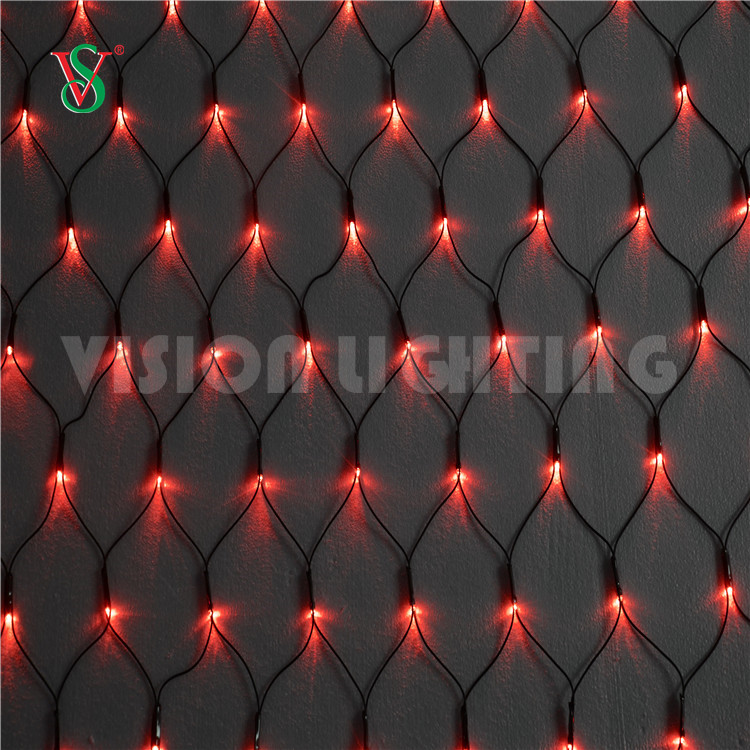
You cannot use standard residential lighting for commercial deployments. Consumer-grade products fail quickly under harsh outdoor conditions. Understanding ingress protection, wire strength, and bulb construction protects your investment.
Standard IP44 residential lights resist minor splashes. They fail miserably in commercial settings. Prolonged exposure to heavy rain and snowpack allows moisture to breach IP44 casings. Freeze-thaw cycles then expand this moisture, shattering the diodes. Commercial projects require an IP67 fairy net light to guarantee survival. An IP67 rating ensures complete dust protection and allows temporary water immersion. Heavy snow accumulations essentially submerge the lights. IP67 certification prevents electrical shorts during these extreme weather events.
Wire thickness dictates durability. Residential sets often use thin 22-AWG or 24-AWG wire. This thin wire snaps under moderate tension. Commercial facades and tall trees experience high wind sheer. You must specify 20-AWG or thicker commercial-grade wiring. Thicker copper cores carry current more safely over long runs. The heavier insulation also prevents abrasion when the wind rubs the wires against brick walls or rough tree bark.
Moisture ingress remains the leading cause of failure in standard LED decorative light displays. Cheaper sets use multi-piece bulb assemblies. Water easily seeps between the plastic lens and the base. To prevent this, commercial matrices utilize epoxy-filled, one-piece bulb construction. Manufacturers inject liquid epoxy into the diode socket during assembly. The epoxy hardens, sealing the electrical components completely. This monolithic design makes the bulb practically indestructible and entirely waterproof.
Commercial installations demand consistent lumen output. Alternating current (AC) naturally pulses, causing an imperceptible flicker. This flicker strains the eyes and ruins architectural photography. Professional net matrices incorporate inline rectifiers. These small cylinders convert the AC power into steady direct current (DC). Rectifiers eliminate the 60Hz flicker entirely. They ensure uniform brightness across massive grid installations, providing a premium aesthetic.
Common Mistake: Do not ignore the rectifier's placement. Installers sometimes bury the rectifier under wet mulch or soil. While water-resistant, rectifiers should remain elevated or wrapped in dielectric enclosures to maximize lifespan.
Accurate measurement dictates the success of your installation. Pre-woven grids lack the flexibility of single strands. You must plan your coverage strategies meticulously to fit specific architectural features and botanical shapes.
Wrapping tree trunks requires careful calculation. Tree trunks are rarely perfect cylinders. They taper as they grow upward. You must measure the circumference at the base and the highest wrap point.
Draping canopies presents different challenges. You need to seamlessly link outdoor tree net lights across continuous hedges or dense foliage. Align the connection nodes carefully. Overlap the edges by exactly one grid square. This overlap prevents dark seams from appearing between connected nets. Secure the overlapping edges together using small zip ties to maintain the grid pattern.
Facade installations require strict matrix dimension calculations. When covering a brick wall, you must account for the overlap allowances. If a wall measures 20 feet wide, and your nets are exactly 5 feet wide, four nets will not suffice. You lose a few inches at each overlapping seam. Always order 10% more width than your raw measurements suggest.
Vertical installations introduce a significant implementation risk known as the "sag effect." Gravity pulls the wire mesh downward. Over a 15-foot vertical drop, the weight of the mesh stretches the top wires. This distortion ruins the uniform grid appearance and eventually snaps the connections. You must factor in the weight of the mesh. Install intermediate load-bearing supports every five vertical feet. Attach tension cables to the wall, and clip the net mesh to these cables to distribute the weight evenly.
We must acknowledge a core truth: net matrices do not work everywhere. They are not a universal solution. Net grids look terrible on sparse, bare-branch winter trees. The structural wire grid becomes highly visible and unsightly against the sky. We highly recommend traditional strings for asymmetrical, bare branches. Reserve net matrices for dense evergreen canopies, solid hedges, and flat architectural surfaces.
Safety and electrical compliance separate professional installers from amateurs. Commercial environments carry strict liabilities. You must follow rigorous protocols to protect public safety and prevent property damage.
You cannot simply plug endless nets together. The National Electrical Code (NEC) governs continuous loads. A continuous load operates for three hours or more. Holiday displays easily meet this definition. You must keep your total amperage below 80% of the circuit's maximum capacity. For a standard 15-amp commercial circuit, you can only utilize 12 amps safely.
Always calculate your maximum continuous load before starting. Check the manufacturer's spec sheet for the exact wattage per net. Divide the total wattage by the voltage (usually 120V) to find the amperage. Respect the limitations on end-to-end connections. Most commercial sets specify a maximum number of connected units. Exceeding this limit causes dangerous voltage drops. The lights at the end of the run will dim. Overloaded wires will heat up and create severe fire hazards. Once you hit the connection limit, you must run a new extension cable directly from the power source.
Proper anchoring prevents wind damage and protects the mounting surfaces.
Commercial deployments demand strict electrical safeguards. Mandatory use of GFCI (Ground-Fault Circuit Interrupter) outlets is non-negotiable. GFCI outlets instantly cut power if water bridges an electrical connection. They prevent fatal shocks.
Use watertight coaxial connections between every net. Standard two-prong plugs separate easily and invite moisture. Coaxial connectors feature threaded O-rings that lock water out. Finally, apply dielectric grease to every connection pin before screwing the caps together. Dielectric grease repels moisture and prevents internal corrosion. It ensures the lights activate flawlessly throughout the entire season.
Sourcing the right hardware determines the long-term success of your lighting program. A cheap upfront price often disguises poor manufacturing. You must evaluate suppliers based on operational guarantees and hardware scalability.
Differentiate clearly between consumer warranties and commercial guarantees. Big-box retail stores usually offer a "90-day" or "single-season" warranty. This timeline implies the product will likely fail after a few months. Commercial suppliers operate differently. Look for manufacturers offering three-to-five-year operational guarantees. These extended warranties prove the supplier uses high-grade epoxy and UV-resistant wire insulation. A commercial warranty protects your initial investment against premature diode failure.
You must plan for future expansion. A major risk involves buying into proprietary connector systems. Some manufacturers design unique plugs that only fit their brand. If that company goes out of business, you cannot replace damaged nets or expand your display. Ensure your supplier uses standard coaxial connectors. Industry-standard plugs allow you to integrate replacement nets seamlessly years later. This standardizes your inventory. It prevents you from discarding perfectly good displays just because you cannot find a matching adapter plug.
Best Practice: Always order 10% more inventory than your project requires. Keep these extra units in your warehouse. They act as immediate hot-swaps if a forklift damages a hedge display or vandals cut a wire. Immediate replacement keeps the client happy and the display flawless.
The true value of LED net matrices lies in the intersection of operational efficiency and commercial-grade durability. They drastically reduce installation hours while delivering a visually perfect, uniform grid. By stepping away from manual stringing, your crews can complete more projects during the short seasonal window. However, you must respect the technical requirements to see these benefits.
Always insist on IP67 waterproof ratings and 20-AWG wiring to survive harsh outdoor environments. Pay close attention to your amperage limits to avoid dangerous circuit overloads. Proper anchoring prevents wind damage and maintains the architectural aesthetics of your display.
Before making a massive inventory purchase, take actionable steps. Conduct a thorough site audit of your target property. Measure the exact dimensions of the facades and foliage. Calculate your total amperage requirements based on those measurements. Finally, order a few sample units. Run a pilot test on a single tree or wall to verify the visual impact and test your chosen mounting hardware.
A: No, you cannot cut them. Cutting the wire severs the electrical circuit, causing entire sections or the full net to fail. Instead of cutting, fold the edges over. You can overlap excess mesh onto adjacent nets or roll the edges neatly and secure them with zip ties to fit specific dimensions.
A: The limit varies by manufacturer, system voltage (120V vs 24V), and wire gauge. A standard commercial 120V system usually allows 15 to 20 sets connected end-to-end. Always check the manufacturer's spec sheet and calculate total amperage to ensure you stay below the 80% continuous load limit of your circuit.
A: IP44 is merely splash-proof and suitable only for covered patios. IP67 means the lights are completely dust-tight and can withstand temporary submersion in water. IP67 is strictly necessary for commercial winter use to survive heavy rain, dense snowpack, and damaging freeze-thaw cycles.
A: Avoid invasive drilling when possible. Use outdoor-rated adhesive facade clips or specialized brick clips that grip the mortar lines. For large vertical drops, drill masonry anchors only at the top of the wall. Run a top-tension wire through the anchors and hang the nets from the wire like curtains to prevent sagging.


