
- Home
- Products
- About Us
- Custom Services
- Solutions
- Resources
- News
- Contact
Views: 0 Author: Site Editor Publish Time: 2026-08-13 Origin: Site


Organizing lighting for commercial Christmas markets demands careful balance. You must weigh festive visual impact against strict electrical safety rules. Event organizers consistently face harsh winter weather and limited power access. Consumer-grade lighting typically fails under these intense operational pressures. High foot traffic and long cable runs cause severe voltage drops over time. These predictable failures create frustrating outages and serious public safety liabilities. We need to build a highly reliable infrastructure for these seasonal events. This ensures your outdoor market shines brightly every single night. You will learn a clear framework for choosing true commercial-grade lighting solutions. We will focus on determining exact bulb spacing metrics for different market zones. You will also explore dynamic control options to deeply engage market visitors. Finally, you will discover how to plan load-safe power distribution networks.
Achieving zero downtime during peak market hours remains absolutely critical. Commercial lighting setups must comply strictly with public space electrical codes. They also require modularity to support future event expansion. Residential lighting simply cannot meet these demanding business requirements.
The core differences begin right at the external cable material. Commercial setups utilize heavy-duty rubber cables rather than cheap PVC variations. Industry-standard H05RN-F rubber stays remarkably flexible even in freezing winter temperatures. This flexibility prevents dangerous structural cracks exposing live electrical wires.
Connectability represents another major technical division between equipment grades. Commercial festoon belt lights feature standardized IP-rated screw connectors. These highly secure joints allow for safe daisy-chaining across large venue spaces. Residential snap-on connectors often pull apart under heavy wind loads.
Socket design also separates professional gear from consumer toys. Molded sockets completely prevent water ingress during heavy rainstorms. Snap-on equivalents inevitably leak and cause system-wide electrical shorts. You must prioritize equipment designed to survive continuous outdoor exposure.
Organizers frequently worry about the initial purchase price. Higher upfront costs for commercial grades make absolute operational sense. They directly reduce ongoing maintenance labor throughout the busy winter season. You also gain a reliable multi-season lifespan from these professional investments.
Choosing the right bulb spacing heavily influences your visual atmosphere. It also dictates your available electrical power budget. Closer spacing demands a much higher wattage draw per linear meter. You must balance visual density against your total venue electrical capacity.
We follow strict standard configuration rules for commercial festival deployments. High-density spacing typically ranges between 0.3m and 0.5m. This dense layout works beautifully for wrapping specific architectural features. It also perfectly frames individual vendor stall fronts to attract buyers.
A spacing of 1.0m remains the recognized industry standard for walkways. Organizers utilize this wider distance for massive overhead suspension systems. You can string them in parallel lines or dynamic zig-zag patterns. This spacing perfectly balances warm ambient light against manageable power loads.
You should also implement unlit extension sections or jumper cables. These blank cables help traverse dark gaps between distinct market zones. They save significant energy by not lighting empty transit spaces.
Table: Spacing Configuration Guidelines
| Spacing Distance | Ideal Application Zone | Power Load Impact | Visual Density |
|---|---|---|---|
| 0.3m - 0.5m | Vendor stall fronts, focal architecture | High (Requires frequent circuits) | Intense, highly concentrated |
| 1.0m | Overhead pedestrian walkways | Moderate (Standard industry baseline) | Balanced, ambient illumination |
| Blank Cables | Empty zones, transit gaps | Zero (Only passes current) | None |
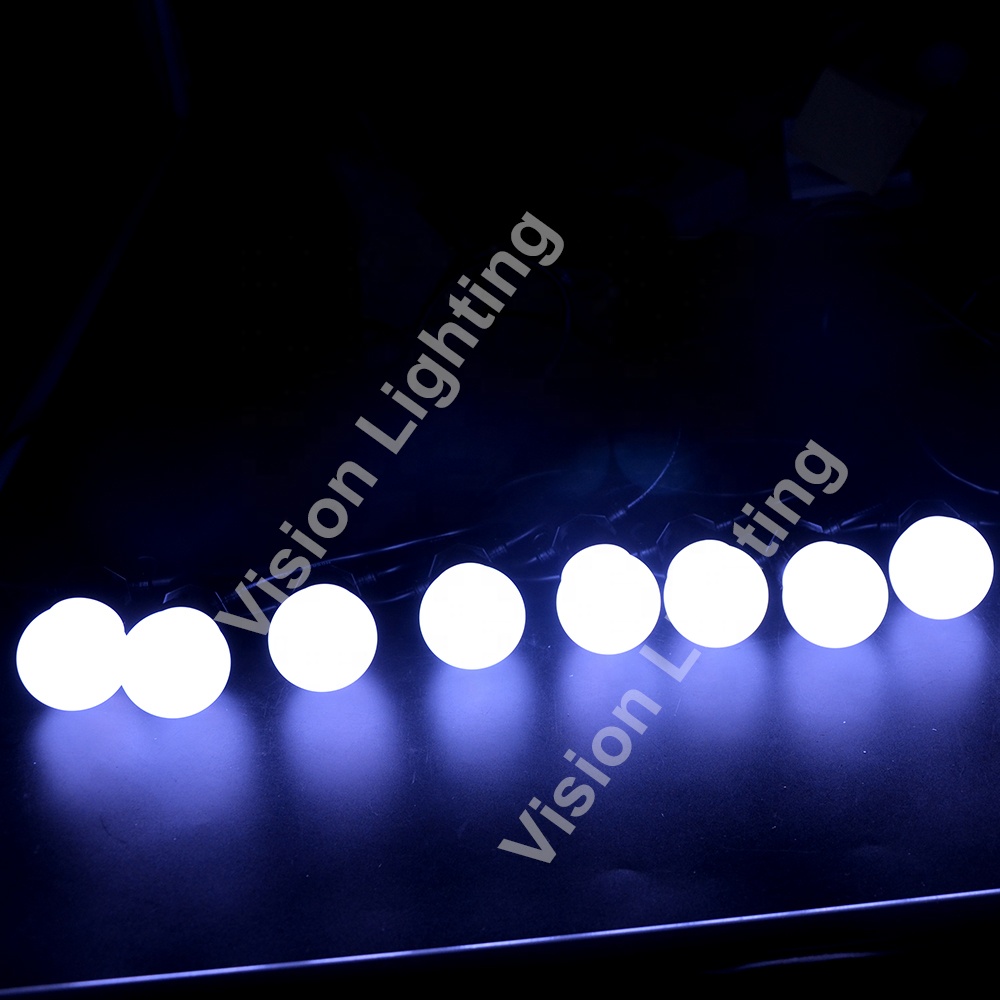
Market organizers must choose between traditional static and modern smart lighting solutions. You can compare single-color installations directly against dynamic pixel control systems.
Static warm white setups offer a classic, nostalgic aesthetic. They typically operate strictly in the 2700K to 3000K color temperature range. These traditional setups cost less and require much simpler power infrastructure. However, they remain entirely inflexible once permanently installed. You cannot easily adapt them to different themes or nightly events.
Dynamic addressable systems change the visitor experience completely. You can integrate programmable ball string lights across the entire venue. These smart systems allow precise individual control over every single bulb.
We highly recommend standard WS2811 bulb string lights for advanced commercial use. This specific IC protocol dominates the professional pixel control market. It empowers you to program sweeping chases, color fades, and music synchronization.
You must evaluate your technical capabilities before upgrading your lighting grid. Does your venue employ the technical staff to manage complex digital controllers? Systems utilizing Art-Net or sACN protocols require specialized network programming knowledge. Alternatively, an app-based pre-programmed commercial controller might prove more practical for small teams.
Power planning strictly dictates the absolute scale of your lighting project. You must calculate the longest permissible cable run before output degrades. Poor planning guarantees dim lights and disappointed visitors.
Organizers frequently debate between using low voltage or mains voltage. Mains voltage systems operate at 110V or 220V depending on region. They allow for massive continuous cable runs across large areas. You can often string 100 to 200 meters continuously without issues. This design minimizes noticeable voltage drop across the entire line. However, mains voltage mandates much stricter safety handling in public spaces.
Low voltage 24V systems offer distinct safety advantages for crowded areas. They remain much safer where the public might accidentally touch cables. Unfortunately, low voltage lines suffer from severe voltage drop over extended distances. You lose significant brightness as the cable stretches further from the source.
You must proactively mitigate this voltage drop when deploying smart pixels. Planning proper power injection points remains absolutely essential. You should inject supplemental power every 10 to 15 meters. This becomes especially critical when running low voltage RGB outdoor lighting. Proper injection guarantees perfect color accuracy across the entire run. It effectively prevents white lights from turning a murky yellow at the end.
Winter markets expose electrical infrastructure to severe environmental risks. Your equipment must survive heavy snow accumulation and sudden high winds. Freezing rain poses a particularly dangerous threat to sensitive electrical connections.
You need to decode IP ratings correctly for public market environments. Many organizers mistakenly believe IP44 ratings provide enough protection. IP44 remains completely insufficient for fully exposed winter markets. You require systems featuring true IP65 or IP67 rated connectors. IP65 components easily resist direct hosedown and blowing snow. IP67 components survive temporary complete water immersion.
Suspension mechanics require careful engineering and reliable mounting hardware. You must install a dedicated catenary guide wire system. Never use the lighting cable itself to bear heavy suspension weight. Long spans become dangerously heavy when heavily burdened by ice or snow. The internal copper wires will simply snap under the tension.
Always utilize proper strain relief techniques at every structural connection point. Consider these best practices for securing your overhead runs:
Selecting the right vendor actively prevents disastrous mid-season failures. You need a strict evaluation checklist for your formal procurement process.
Follow these mandatory steps when reviewing potential lighting suppliers:
These checks ensure you invest in truly reliable festoon belt lights. Do not compromise on technical documentation.
You should take immediate next steps to advance your project safely. Map out your precise site layout using accurate venue blueprints. Calculate the total linear meters required for your final design. Determine all available power access points across the outdoor footprint. Finally, request a physical mock-up sample from your chosen manufacturer to test durability.
Successful Christmas market lighting relies less on the light bulb itself. It depends almost entirely on the underlying commercial electrical infrastructure. You must prioritize robust rubber cabling and calculated circuit power limits. Choosing the appropriate physical bulb spacing ultimately ties the entire visual design together.
We highly recommend upgrading for high-budget and high-engagement outdoor markets. Transitioning to dynamic addressable systems offers incredible return on overall visitor experience. Synchronized light shows naturally encourage guests to stay longer and interact more. You must simply ensure your power infrastructure supports demanding pixel-level voltage requirements. Smart planning guarantees a safe, spectacular, and memorable winter season.
A: Maximum connectable limits depend entirely on your operating voltage and individual bulb wattage. You can typically run up to a 1500W total load on a standard mains circuit. Always refer to the manufacturer's official maximum run length charts. Overloading a circuit causes severe voltage drops and creates serious fire hazards.
A: Yes, they require clean, continuous DC power to function correctly. Most commercial WS2811 pixels operate efficiently on 12V or 24V power supplies. You will also need strategically placed power injection points along long runs. Finally, you must connect a compatible data controller to manage the dynamic lighting effects.
A: High-quality commercial versions absolutely survive harsh freezing temperatures. You must choose professional models featuring commercial-grade resin-filled nodes. These sealed waterproof units protect the internal IC chips from moisture expansion. Avoid cheap consumer plastics, which quickly turn brittle and shatter during deep winter freezes.
A: You must implement a dedicated steel catenary tension wire system. Never hang the electrical cable directly across long, unsupported spans. Use heavy-duty UV-rated zip-ties or metal carabiners to attach the lighting string to the tension wire. This approach relieves dangerous physical strain from the internal copper electrical wires.


