
- Home
- Products
- About Us
- Custom Services
- Solutions
- Resources
- News
- Contact
Views: 0 Author: Site Editor Publish Time: 2026-08-05 Origin: Site


Designing commercial holiday displays involves incredibly high operational stakes. Planners must constantly balance stunning visual impact against strict public safety protocols. You also have to navigate unpredictable winter weather and tightly managed procurement budgets. Moving from residential string lights to commercial-grade infrastructure requires a major strategic shift. You absolutely cannot rely on consumer-grade materials for large public spaces. Flimsy frames and poor waterproofing often lead to mid-season failures. These failures create hazardous conditions for pedestrians and vehicles alike. This article provides a comprehensive technical evaluation framework. Property managers, city planners, and commercial decorators will learn exactly how to source reliable motif lighting. We will explore structural mounting requirements, electrical safety standards, and vendor vetting processes. By the end, you will know how to specify the right lighting for your municipal streetscapes or retail environments.
Selecting the right frame material (aluminum vs. steel) dictates the lifespan and maintenance costs of outdoor motif lights.
Mounting locations (pole-mounted vs. over-the-street) require distinct weight limits, wind-load ratings, and rigging hardware.
Commercial LED motif decorations must possess verified IP65+ waterproofing and commercial-grade voltage configurations to ensure compliance and public safety.
Transitioning from flat 2D profiles to a 3D motif light increases visual footprint but requires stricter structural support and storage planning.
Every commercial light installation demands careful structural planning before you even look at a catalog. You must thoroughly evaluate where the display will hang before ordering any units. Over-the-street displays face intense aerodynamic stress from winter storms. These suspended setups require ultra-lightweight frames and exceptionally high wind-shear resistance. High wind gusts easily turn heavy decorations into dangerous swinging pendulums over busy traffic lanes. Pole-mounted designs face completely different physical challenges. They require specialized bracket compatibility to grip concrete or metal safely. Installers often use heavy-duty stainless steel banding straps. They pair these with rigid standoff brackets. These tools protect the municipal pole finish while keeping the fixture locked firmly in place.
Commercial entrances and mall facades require a highly specific sizing logic. The typical viewing distance directly dictates your optimal display scale. Pedestrians walking close to a building appreciate highly detailed, smaller fixtures. Highway drivers passing by need massive, high-contrast outlines just to recognize the bell shape. If you mount a fixture 30 feet high, a standard three-foot bell looks incredibly tiny. You must scale up the fixture size dramatically as the mounting height increases. This ensures the visual impact remains strong from afar.
Frame material realities heavily dictate your project's longevity. Buyers usually choose between powder-coated aluminum and treated steel frames. Aluminum offers massive structural advantages for outdoor use. It remains naturally rust-proof and very lightweight. These critical traits easily offset its higher upfront cost. Treated iron or steel costs much less initially. However, it weighs significantly more, complicating the rigging process. It also risks severe rust if the protective coating chips during transit or installation. We highly recommend aluminum frames for all professional projects. They excel particularly in coastal areas and high-precipitation zones where salt and water destroy steel.
Choosing the correct visual dimension affects both your aesthetics and your backend logistics. 2D motif lights provide excellent practical advantages for specific commercial applications. They work perfectly for flat surface mounting on brick building walls. They also suit standard municipal lamp posts and cross-street suspension wires perfectly. A 2D profile maintains a remarkably low weight profile. This characteristic makes high-altitude rigging much safer and significantly easier for bucket-truck crews. They also offer incredible efficiency in off-season storage. You can easily stack dozens of flat units in a small warehouse corner. This strategy saves thousands of dollars in commercial storage fees over the years.
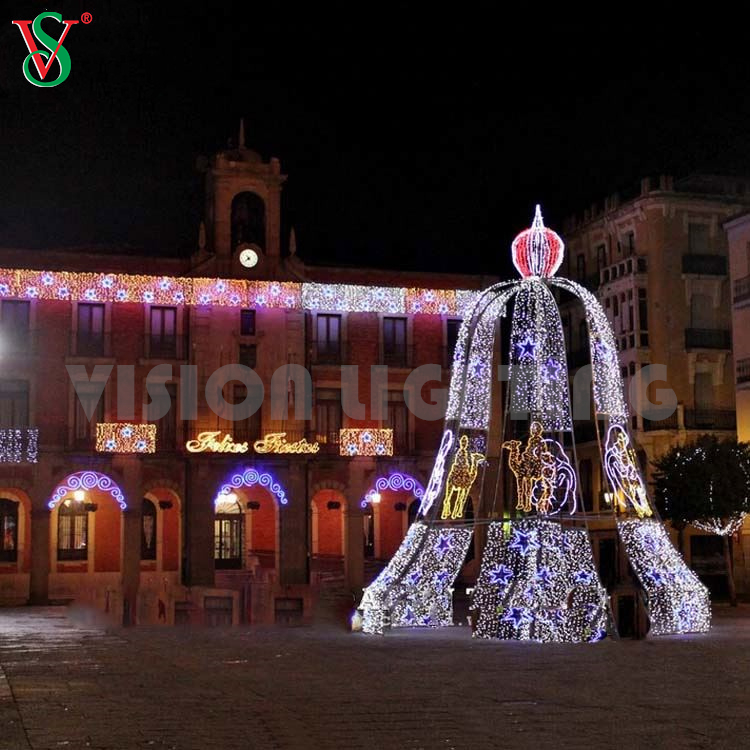
Stepping up to a three-dimensional display drastically changes your engineering requirements. A 3D motif light demands substantial structural support and a larger physical footprint. You often see these grand pieces placed at ground level in town squares. They also serve as stunning, photogenic centerpieces in traffic roundabouts. If you deploy a massive giant Christmas bell light, you must securely anchor its wide base. Winter wind can easily tip over bulky freestanding structures. Professional installers must always use deep ground stakes, weighted sandbags, or heavy bolted base plates.
Visual density relies on clever bulb combinations engineered at the factory. Manufacturers often blend different LED types to achieve a standard commercial aesthetic. They usually use thick LED neon rope lights to create crisp, defined structural outlines. They then use standard LED string lights for the internal glowing fill. This specific combination provides exceptionally bright, dense illumination. It achieves this vibrant look without adding excessive weight to the internal aluminum frame.
Technical specifications strictly separate professional fixtures from cheap retail decor. When evaluating commercial LED bell motif lights, ingress protection (IP) ratings remain non-negotiable. You must establish IP65 as your absolute baseline for full outdoor exposure. This specific rating ensures the fixture safely resists powerful water jets and heavy melting snow. IP44 is completely insufficient for harsh commercial winter environments. Water intrusion quickly shorts out IP44-rated electronics, causing massive display outages.
Electrical configurations directly impact your venue's public safety. Buyers usually compare low-voltage and line-voltage systems during the sourcing phase. Line-voltage systems run directly on standard 110V or 220V power. They often simplify large daisy-chained setups across long building rooflines. However, low-voltage systems operating at 24V or 36V provide massive safety advantages. These systems use specialized step-down transformers to reduce current. We highly recommend low-voltage options in pedestrian-heavy areas. They completely eliminate the risk of severe electric shock if wires become accidentally exposed.
You must set highly realistic expectations for lumen depreciation and overall LED lifespan. Do not fall for exaggerated marketing claims from unverified trading companies. Look for reputable suppliers guaranteeing 30,000 to 50,000 hours of continuous operation. The exterior casing material also matters immensely for light quality. Ensure the factory uses UV-resistant PVC casing around the diodes. Standard cheap plastics turn cloudy and yellow under prolonged sun exposure. They also crack easily when exposed to freezing winter temperatures.
System Type | Operating Voltage | Primary Advantage | Ideal Commercial Application |
|---|---|---|---|
Line-Voltage | 110V / 220V | Longer continuous runs | High building rooflines, secure municipal poles |
Low-Voltage | 24V / 36V | Superior public safety | Ground-level displays, interactive mall paths |
Physical stress from harsh winter weather frequently destroys weak installations. Severe wind load and sudden ice accumulation present constant, unpredictable threats. Suspended fixtures gather heavy coats of ice during freezing winter storms. This ice multiplies the hanging weight of the frame exponentially. Installers must address this extreme physical stress proactively. You must use structural steel guy-wires to stabilize large hanging profiles. Ensure your chosen commercial LED motif decoration features reinforced double-welding points. Standard single spot welds snap instantly under heavy wind shear.
Meticulous electrical planning prevents catastrophic display failures. You need a solid mathematical framework for calculating maximum continuous power loads. Municipal street light circuits typically feature very strict amperage limits. Do not overload them under any circumstances. Always calculate the total combined wattage of your new displays. Include a mandatory 20-percent safety buffer for all continuous loads. This standard practice prevents unexpected breaker trips during peak winter weather events. A tripped breaker easily leaves entire commercial city blocks in total darkness.
Storage creates unexpected logistical hurdles for facility managers every spring. Planners often ignore post-season maintenance during the initial purchase rush. Oversized bells and glowing spheres consume massive amounts of warehouse space. We strongly recommend folding structures for larger custom decorations. Smart modular designs break down rapidly into flat, manageable components. This strategy dramatically minimizes your off-season warehouse footprint. Proper storage practices directly extend the operational life of your aluminum frames and LED ropes.
Audit the existing municipal circuit capacity before placing large orders.
Group low-voltage transformers on dedicated, waterproof commercial power strips.
Apply a 20-percent safety margin strictly below the breaker limit.
Inspect all connection points for water ingress daily during the holiday season.
Procurement teams must vet overseas suppliers rigorously before sending any deposits. Never base your purchasing decisions purely on beautiful aesthetic photos. You must validate the factory credentials directly with the source. Advise your sourcing buyers to check for verified, international certifications. Look closely for valid CE, RoHS, and UL or ETL markings. These specific certifications prove the manufacturer follows strict global electrical safety guidelines. Always request recent test reports to verify IP ratings and fire-retardant casing claims.
Project timelines dictate your available product options heavily. You must evaluate shipping lead times carefully. Custom sizes require significantly longer engineering and production windows. Specific bell colors also add weeks to manufacturing time. A standard warm white fill might ship immediately from existing inventory. A custom traditional gold and red pattern may take several weeks to build. Off-the-shelf items always ship much faster. You should order custom designs at least four to five months before the planned installation date.
Business-to-business purchasing carries very standard commercial expectations. Be fully prepared to negotiate Minimum Order Quantities (MOQ) with factories. Many manufacturers require large bulk orders for custom colors or unique frame sizes. You must also scrutinize the offered warranty terms carefully. We recommend demanding a minimum one-year comprehensive warranty. This warranty should explicitly cover both premature LED failure and structural frame degradation. Do not accept weak warranties that conveniently exclude rust or diode discoloration.
Ignoring long ocean freight transit times for international container orders.
Failing to specify exact frame materials during the initial quotation phase.
Assuming heavy-duty mounting hardware comes included in the base price.
Overlooking the urgent need for spare connection cables and extra bulbs.
Successful holiday lighting deployments rely heavily on strict baseline requirements. Your commercial displays demand lightweight, fully rust-proof aluminum frames. They require verified IP65+ waterproofing for guaranteed outdoor survival. You must also secure them using tested, professional-grade mounting hardware. Overlooking any of these critical elements guarantees premature display failure.
Smart buyers focus intensely on long-term durability over the lowest unit price. Cheap decorations ultimately cost much more in constant repairs and early replacements. Investing in true commercial-grade materials ensures public safety and reliable performance year after year. Evaluate your supplier based on high-quality components and completely transparent warranty terms.
Take immediate action before the holiday manufacturing rush begins. Assess your current commercial installation sites thoroughly. Calculate the structural capacities and electrical limits of your lamp posts and facades. Reach out to verified direct manufacturers to request a comprehensive technical specification sheet. Request a detailed wholesale quote today to secure your municipal inventory early.
A: Commercial street lights utilize both line-voltage and low-voltage systems. Line-voltage (110V/220V) allows for longer continuous runs without voltage drop. However, many municipalities now require step-down low-voltage systems (24V/36V). These low-voltage options maximize public safety in pedestrian zones by eliminating electrocution risks.
A: Yes, provided it utilizes a wind-load engineered frame. Heavy storms require commercial fixtures built from powder-coated aluminum with reinforced welding. Installers must also use proper rigging techniques, including guy-wires and heavy-duty ground anchors, to prevent wind shear damage.
A: Installers use specialized hardware to prevent pole damage. They secure mounting plates using heavy-duty stainless steel banding straps. Standoff arms then push the light fixture away from the pole. This prevents scratching and ensures the decoration clears passing traffic safely.
A: This depends entirely on the specific construction. Modular string light fills allow you to replace individual bulbs or strands easily. However, continuous LED neon rope lights function as sealed units. If a section fails, you typically replace the entire rope segment to maintain waterproofing.


