
- Home
- Products
- About Us
- Custom Services
- Solutions
- Resources
- News
- Contact
Views: 0 Author: Site Editor Publish Time: 2026-07-18 Origin: Site


Municipal planners, city engineers, and BID managers know holiday displays go beyond mere aesthetics. You treat these installations as critical urban infrastructure projects. Planners face a unique challenge every holiday season. You must balance the commercial desire to drive foot traffic against strict engineering realities. Display installations require careful attention to wind loads, electrical code compliance, and structural pole integrity.
A single miscalculation can compromise public safety. It can also trigger widespread municipal grid overloads. This guide offers a comprehensive operational framework for your municipal lighting projects. You will learn how to evaluate, plan, and deploy street pole Christmas lights across varied urban environments.
We explain how to navigate infrastructure audits efficiently. You will discover how to select commercial-grade fixtures confidently while adhering to strict safety protocols. We also detail specific layout strategies tailored to both high-speed vehicular arteries and dense pedestrian zones.
Evaluating your infrastructure forms the bedrock of any holiday lighting project. You cannot simply strap decorations to municipal poles and hope for the best. Local departments must conduct rigorous baseline audits to prevent accidents. Structural failures during winter storms pose severe liabilities for municipalities.
Wind loads exert massive force on elevated structures. You must execute a systematic approach to pole evaluation before approving any design.
You must ensure installations withstand local wind and ice loads. They must never compromise the structural integrity of the light pole.
Power accessibility dictates your design limitations. You need to determine the primary power sources early in the planning phase. Some municipalities prefer direct hardwiring into street light circuits. Others mandate photo-cell tap-ins or dedicated seasonal outlets. Direct hardwiring requires licensed municipal electricians to splice connections safely. Photo-cell adapters offer a modular, plug-and-play alternative.
You must calculate the maximum amperage draw per city block. Municipal grids often run near peak capacity during winter evenings. Overloading a circuit will trip breakers and darken entire intersections. You must mandate high-efficiency LED specifications for every street motif light to minimize power draw.
Navigation of local regulations requires patience and precision. You must satisfy Department of Transportation (DOT) and public works requirements. Clearance heights remain the most strictly enforced metric across urban environments.
Standard municipal codes mandate 14 to 18 feet of vertical clearance for vehicular roads. This specific height accommodates tall delivery trucks and large emergency response vehicles. Pedestrian paths allow lower clearance heights, usually around 10 to 12 feet, creating a more intimate atmosphere.
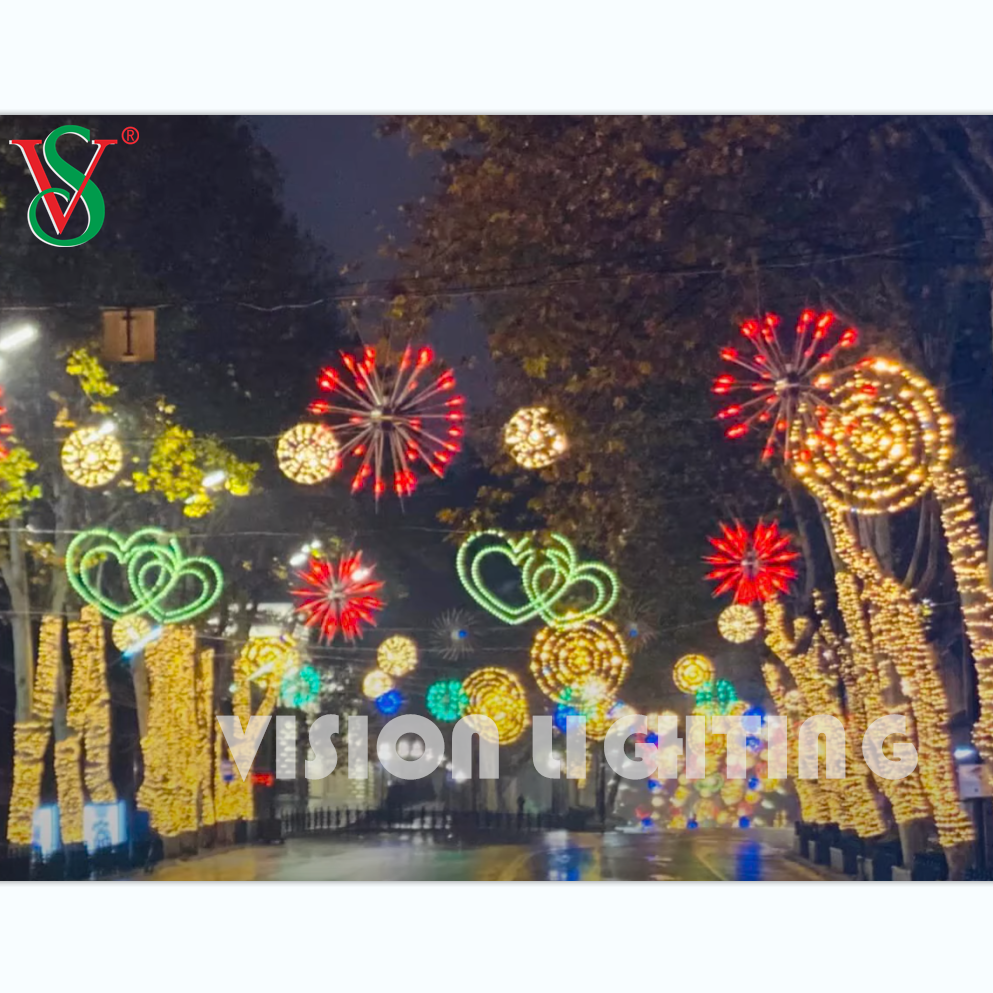
High-traffic arteries demand strict adherence to safety protocols. Drivers moving at 45 miles per hour process visual information differently than walking pedestrians. Your design must account for driver psychology and vehicle speeds.
Safety standards strictly regulate roadside illumination. Decorative elements must never mimic or obscure critical traffic signals. You should avoid installing bright red or solid green circles near intersections. These specific colors confuse drivers and cause dangerous sudden braking. The Federal Highway Administration (FHWA) emphasizes maintaining uniform visibility guidelines.
You must maintain compliance with standard luminaire arrangement principles. Displays should never create blinding glare. Shielded LEDs or diffused rope lights help maintain driver focus. Clear visibility ensures traffic flows smoothly throughout the holiday season.
Urban layout strategies generally fall into two primary categories. You must choose between symmetrical or staggered arrangements based on your specific street topology.
Travel speed dictates design scale. Drivers cannot appreciate intricate scrollwork at high highway speeds. You should prioritize large-scale 2D motif light designs for vehicular roads.
High-contrast LED rope or commercial string lighting works best. Bold geometric shapes allow for rapid visual processing. Simple snowflakes, giant stars, or sweeping ribbons communicate the holiday theme instantly. Bright, clear outlines ensure drivers recognize the festive elements without distraction.
Pedestrian zones require an entirely different layout philosophy. Walkways, commercial plazas, and historic shopping districts thrive on intimacy. Your goal shifts from fast visual processing to environmental immersion.
You must shift your focus from immense scale to fine detail. Pedestrians interact with lighting at much slower speeds. They view installations from mere feet away, noticing craftsmanship and color quality. You should lower mounting heights wherever local city codes permit.
Lower fixtures create an immersive, canopy-like atmosphere. This human-scale approach makes expansive public spaces feel cozy and inviting. It transforms cold winter sidewalks into warm, welcoming environments.
Pedestrian layouts thrive on high-density lighting applications. You should increase the frequency of installations per block. A dense lighting strategy transforms a barren sidewalk into a true holiday destination.
You can integrate pole lights seamlessly into surrounding municipal infrastructure. Wrap adjacent tree trunks using commercial mini-lights to match the pole motifs. Suspend cohesive cross-street banners between the decorated light poles. These layered techniques create deeply immersive retail environments.
Business Improvement Districts rely heavily on holiday displays to drive seasonal revenue. High-quality illumination directly influences consumer behavior and foot traffic. You should deploy highly detailed or custom-branded outdoor Christmas street lights to anchor these spaces.
Beautiful installations serve as local landmarks. Aesthetically pleasing areas encourage heavy social media sharing. Visitors take photos and tag local businesses online. This organic marketing extends shopper dwell times. Increased dwell time directly boosts local retail and restaurant sales.
Aesthetic planning means nothing without robust mounting hardware. Harsh winter weather routinely destroys poorly secured fixtures. You must prioritize industrial-grade attachments, weatherproofing, and smart engineering.
You must evaluate different mounting systems carefully. City engineers typically choose between banding systems and bolt-on brackets. You must specify brackets featuring integrated wind-spilling designs. Top-tier manufacturers include breakaway components. These components fail intentionally during hurricane-force gusts. Losing a decorative fixture is always preferable to snapping a main municipal light pole.
| System Type | Pros | Cons | Ideal Application |
|---|---|---|---|
| Banding Systems (Stainless Steel) | Preserves pole warranty; no drilling required; highly adjustable. | Can slip on tapered poles under extreme vibration. | Fiberglass poles, decorative historic posts, painted columns. |
| Bolt-On Brackets | Maximum weight-bearing capacity; permanent structural hold. | Requires drilling; voids some pole warranties; invites internal rust. | Heavy steel poles, high-wind corridors, massive 3D motifs. |
You must enforce strict durability minimums during the procurement phase. Require minimum IP65 ratings for water and dust ingress. This international rating ensures internal electrical components survive freezing rain, sleet, and urban pollution. It prevents premature short circuits.
You must mandate UV-resistant powder-coated aluminum frames. Raw steel frames rust incredibly quickly in wet winter environments. Rust bleeding stains municipal concrete sidewalks. It also ruins freshly painted poles, creating expensive spring cleanup projects for the city.
Installation labor often forms a massive portion of the seasonal budget. You must evaluate the labor hours required for both installation and removal. Look for modular designs featuring quick-connect waterproof wiring harnesses.
These modern connectors eliminate the need for dangerous field splicing. City crews can simply plug fixtures together while wearing heavy winter gloves. Faster takedowns save municipalities thousands of dollars in bucket-truck rental fees. Efficient removal also minimizes traffic lane closures.
Choosing the right manufacturing partner guarantees long-term project success. Municipal procurement requires a strategic evaluation of vendor capabilities, production speed, and reliability.
You must determine your specific design requirements early in the year. Standard off-the-shelf motifs offer fast delivery and proven reliability. They work perfectly for standard snowflakes, traditional holiday bells, or classic stars.
However, many cities want unique civic branding to stand out. Assess whether the vendor can adapt standard motifs to local city themes. A coastal town might want illuminated sailboats alongside traditional holiday elements. You must verify the manufacturer’s lead times for large-scale municipal orders.
Custom fabrication usually requires three to six months of runway. You cannot order custom municipal lighting in October and expect a Thanksgiving delivery. Planners should issue Request for Proposals (RFPs) during the early spring months to secure priority production slots.
A: Wind load is calculated using the motif's Effective Projected Area (EPA) combined with local peak wind speed data. Manufacturers should provide the EPA of their fixtures, which city engineers will check against the existing pole's maximum rating.
A: Yes, typically via a photocell adapter or by tapping into the pole's internal wiring, provided the added LED amperage does not exceed the circuit's capacity. Licensed municipal electricians must verify code compliance.
A: While local codes vary, standard practice dictates a minimum of 14 feet over sidewalks and 18 feet over vehicular roadways to accommodate delivery trucks and emergency vehicles.
A: Commercial-grade units utilize heavy-gauge aluminum frames, stainless steel mounting hardware, and IP65+ rated commercial LEDs designed to withstand continuous exposure to urban pollution, vibration, and extreme weather.


