
- Home
- Products
- About Us
- Custom Services
- Solutions
- Resources
- News
- Contact
Views: 0 Author: Site Editor Publish Time: 2026-03-05 Origin: Site


If you want the brightest results from strip lighting, you should look at 5050 strip light options, high-density led strip lights, and modern COB designs. Many people agree—about 60% of buyers put brightness at the top of their list when shopping for lighting. The main things that boost led brightness include the size and type of each led, how many leds you get per meter, and the power each strip pulls. You also need to think about heat control for the best performance from your led setup.
Choose 5050 or COB LED strips for the brightest lighting. They provide the highest lumens and efficiency.
Higher LED density means more brightness. Look for strips with 60 or 120 LEDs per meter for better illumination.
Manage heat effectively to maintain brightness and extend the life of your LED strips. Use heat sinks and ensure good airflow.
Select the right power supply to match your LED strips. This prevents brightness drops and ensures safety.
Use reflectors and diffusers to enhance light quality. They help create a softer, more even glow in your space.
You might wonder why some led strip lights look much brighter than others. The answer often comes down to the chip size and type. Bigger chips usually mean more lumens and better efficiency. Take a look at this table to see how different chips compare:
LED Type | Chip Size (mm) | Max Current (mA) | Luminous Output (LM/LED) |
|---|---|---|---|
SMD5050 | 5.0 x 5.0 | 60 | 20 |
SMD5630 | 5.6 x 3.0 | 150 | 55 |
The size of the chip determines the luminous efficiency of the led lamp beads. The larger the chip size, the higher the luminous efficiency of the led lamp beads. SMD 2835 diodes are also popular for their high efficiency and smooth light diffusion. You can find them in high densities, which helps you get a continuous light effect with no gaps.
LED density means how many leds you get in each meter of strip light. Higher density gives you more lumens and better brightness. Here’s a quick look:
LED Density (LEDs/M) | Lumen Output |
|---|---|
30 | Lower |
60 | Higher |
To achieve higher lumens, you need to consider both the led chip and the density of the strip light. Denser strips always give you higher lumen outputs. Standard density is 30 leds per meter, but high-density strips can go up to 60 or even 120 leds per meter.
You want your led strip lights to shine at their brightest, right? Make sure your power supply matches the voltage and current needs of your strip light. If the power supply can’t keep up, you’ll see a drop in brightness. Here’s what you should remember:
Voltage drop happens as electricity travels down the strip.
Longer runs can lose brightness at the end.
Keep standard density strips under 32 feet and high-density strips under 16.4 feet for best efficiency.
Heat can hurt the efficiency and performance of your led strip lights. High temperatures cause lumens to drop and can shorten the life of your strip lighting. Good heat management uses materials with high thermal conductivity, heat sinks, and sometimes even active cooling. This keeps your led strip lights bright and efficient for a long time. You’ll also notice better color rendering index and more stable brightness when you manage heat well.
Tip: Always check the color rendering index when you shop for led strip lights. High CRI means colors look more natural and vibrant.
You want to pick the best performer for your space, right? Let’s break down the most popular led strip lights. You’ll see three main types: 5050, 2835, and 3528. Each one has its own strengths for brightness and energy use.
Here’s a quick table to help you compare:
LED Type | Brightness Comparison | Typical Use Case |
|---|---|---|
3528 | Least bright | Accent lighting |
5050 | 3 times brighter than 3528 | Task lighting |
2835 | Much brighter than 3528 | Task and work lighting |
If you want the best overall strip for high lumens, 5050 led strip lights stand out. They give you three times the brightness of 3528 strips. You can use them for task lighting or anywhere you need a lot of light. 2835 led strip lights also shine bright and use less energy. They work well for both task and work lighting. 3528 strips are better for accent lighting because they don’t get as bright.
Let’s look at energy efficiency too:
LED Type | Energy Efficiency |
|---|---|
2835 | Best |
3528 | Moderate |
5050 | Least |
So, if you want high efficiency and strong lumens, 2835 led strip lights are a smart pick. If you want the brightest possible output, 5050 led strip lights are your best performer. You can also find color changing options and tunable white led strips in these types, which adds even more flexibility.
You might want even more brightness and smoother light. High-density led strip lights pack more led chips into every meter. The maximum density you’ll find in commercial strips is 112 LEDs per meter. Some specialty strips, like 2110SMD, can go up to 700 LEDs per meter. That’s a lot of lumens!
Here’s what you get with high-density led strip lights:
More led chips per meter means higher brightness and more even light.
High-density strips work great for workspaces, kitchens, or anywhere you need strong, steady light.
You can use high cri strip lights for better color accuracy and full spectrum cri for natural-looking colors.
But remember, more led chips also means more heat. High lumen led strip lights produce extra heat because of the power density. If you don’t manage the heat, you might see color shifting, lower brightness, or even early failure. You need good thermal management, like heat sinks, to keep your led strip lights working at their best.
Tip: Always check for advanced cooling solutions if you plan to use high-density led strip lights in tight spaces.
COB led strip lights are a new option for people who want the smoothest and brightest light. COB stands for “chip on board.” These strips use lots of tiny led chips packed close together. You get a continuous line of light with no visible dots or gaps. This makes COB led strip lights perfect for places where you want even, soft light—like under cabinets or behind TVs.
COB led strip lights often have more than 400 chips per meter. This high chip density gives you strong lumens and a smooth look. You won’t see the “dotted” effect that sometimes happens with regular SMD strips. The design of COB led strip lights also helps with heat management, so you get stable brightness and longer life.
If you want the best performer for uniform brightness, COB led strip lights are a top choice. You can find color changing led strips and tunable white led strips in COB style too.
Let’s check out some of the highest-rated strip light models for brightness:
Model | Brightness Rating | Notes |
|---|---|---|
L8Star Smart LED | Highest | Brightest uncoated type tested |
Pangton Villa | High | Next brightest uncoated type |
Armacost | High | Brightest and truest white light |
You can use these options for your next project if you want the best performer in brightness and quality.
Note: Always match your led strip lights to your needs. Think about brightness, color changing options, and how much heat your setup will make. This way, you get the best results for your space.
You want your strip light setup to shine as bright as possible, right? Start with a good plan for your installation. Think about where you want to put your led strip lights. Surface mounting works well if you want easy access. Recessed installation gives you a clean look. Use mounting channels to help with heat management and keep your led strip lights cool. Aluminum channels or heat sinks pull heat away from the led chips, so you get more lumens and longer life.
Here are some quick tips for your led strip light installation:
Always clean the surface before you install led strip lights.
Use mounting channels for better heat dissipation.
Avoid putting strip lights in tight spaces with no airflow.
Try smart controls to adjust brightness and color temperature.
If you want to cover a big area with strip lighting, you might need more than one strip light. Long runs can lose lumens at the end because of voltage drop. You can fix this by using multiple power supplies. This keeps the brightness even from start to finish. Power injection points help spread power across your led strip lights, so every part stays bright. When you use the right power supply, you also make your installation safer and more reliable.
Check out this table to see how different power supplies affect your setup:
Power Supply Type | Impact on Brightness | Impact on Safety |
|---|---|---|
Constant Voltage | Gives steady voltage for even lumens. | Can overheat if voltage is wrong. |
Constant Current | Keeps current steady, prevents overheating. | Best for high-power led strip lights. |
Dimmer-Compatible | Lets you adjust brightness. | Needs to match your led strip lights to avoid issues. |
Want to make your led strip lights look even better? Add reflectors and diffusers to your installation. Diffusers spread out the light, so you don’t see harsh spots or glare. They also help blend the lumens, making your space feel softer and more comfortable. Reflectors focus the light and boost the brightness, which is great if you need more light in one spot.
Diffusers soften the light and reduce glare.
They stop bright spots from shining in your eyes.
Reflectors increase the intensity and help direct the lumens where you need them.
Using both together gives you smooth, even strip lighting with no harsh shadows.
Tip: If you want the best results, always use diffusers and reflectors in your led strip light installation. You’ll get more lumens and a better look for your space.
You want your space to look great and feel comfortable. Start by thinking about what you need from your led strip lights. Every room is different, so you should check a few things before you buy.
Brightness levels matter. Look for lumens on the package. More lumens mean more light.
Color temperature changes the mood. Warm light feels cozy. Cool light works best for tasks.
Measure your space. Make sure your strip light fits the area. Some led strip lights bend around corners, which helps in tricky spots.
Check the power supply. It must match your led strip lights for the best performance.
If you want outdoor strips, look for waterproof ratings like IP65 or IP67. These keep your led strip lights safe from rain and dust.
Good materials last longer. High-quality led strip lights stay bright for years.
You can use indoor strips for bedrooms, kitchens, and offices. Outdoor strips work well for patios, gardens, and even bathrooms. Tunable white led strip lights let you change the color temperature for any mood.
You want bright light, but you also want to save energy. Led strip lights use less power than old bulbs. This means you get strong lumens without high bills.
Here’s a quick table to help you balance your choices:
Factor | Description |
|---|---|
Lumen Output | More lumens give you brighter strip lighting. |
Wattage | Lower wattage means better energy savings. |
Energy Star | This label shows your led strip lights are efficient and reliable. |
Tunable white led strip lights let you adjust the brightness for reading, working, or relaxing. You can use indoor strips in offices to reduce eye strain. Outdoor strips with adjustable lumens work well for parties or quiet evenings.
Tip: Always match the length of your led strip lights to your space. Too many strips can overload your power supply.
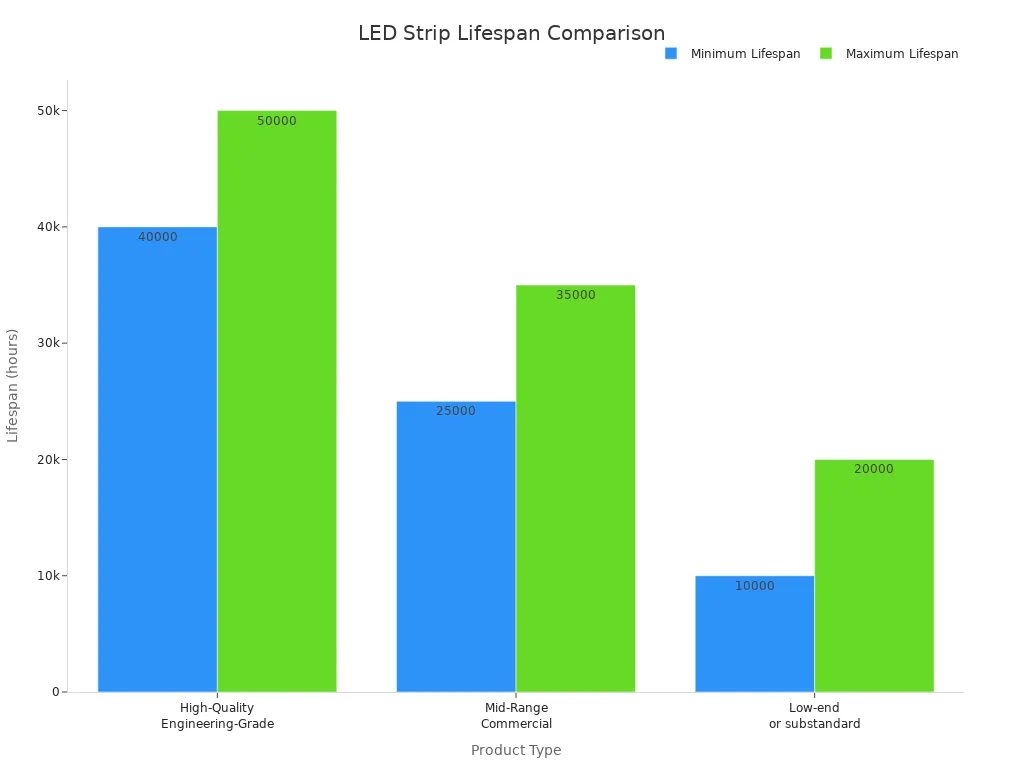
You want your led strip lights to last and stay safe. High-quality led strip lights can shine for up to 50,000 hours. That’s years of bright, steady light. Check out this chart to see how long different strip light types last:
Here’s a table to help you pick the safest option:
Type of LED Strip | Safety Considerations |
|---|---|
High Voltage | Needs insulation and waterproofing. Best for outdoor strips. Ask a pro to install. |
Low Voltage | Safe for indoor strips and DIY projects. Good for kitchens and bedrooms. |
Keep your led strip lights clean with a soft cloth. Replace damaged sections right away. Use tunable white led strip lights for both indoor and outdoor strips. They give you the right lumens for every moment.
Note: Always look for certifications like UL, Energy Star, or RoHS. These show your led strip lights are safe and meet high standards.
You can pick from many led strip lights if you want more brightness. Some models, like Govee Strip Light 2 Pro, are very bright and simple to use. Tapo L930-5 and TP-Link Tapo are also easy to set up. Always read the instructions from the company before you start. Use the correct power supply so your led strips stay bright. Look at your room and choose the strip light that works best for you.
LED Strip Light Model | Brightness | Usability |
|---|---|---|
Govee Strip Light 2 Pro | High | User-friendly |
Tapo L930-5 | Moderate | Easy |
TP-Link Tapo | Moderate | Very easy |
WiZ | Low | Straightforward |
You get more brightness from bigger LED chips, higher LED density, and a strong power supply. High-density strips and 5050 or COB chips shine the brightest.
Yes, you can cut most LED strips. Look for the marked cut lines on the strip. Always use sharp scissors and follow the instructions from the manufacturer.
LED strips stay cool compared to old bulbs. High-brightness strips can get warm. Use aluminum channels or heat sinks to keep them cool and safe.
You can use a dimmer switch or a smart controller. Some LED strips come with remote controls or apps. Adjust the brightness to match your mood or task.


